Traditional urban lighting systems are undoubtedly facing systemic challenges, the core of which is high energy consumption and environmental load. The dependence of traditional lighting on the power grid has not only led to a continuous increase in operating expenses, but also ran counter to the increasingly stringent global carbon emission targets. The carbon footprint of coal-fired power generation makes traditional street lamps under scrutiny on environmental issues. At the same time, high maintenance costs, including frequent component replacement and complex grid maintenance, have undoubtedly increased the financial burden of cities. In this context, solar street lights, with their self-sufficient energy model and significant environmental benefits, are rapidly becoming the key to breaking the situation.

Solar street lights: the future of urban lighting has come
Energy independence and energy efficiency:
Compared with an ac led street light that depends on grid electricity, solar street lights achieve greater energy independence by generating and storing power locally. Advances in photovoltaic technology, LED efficiency, light sensing, and infrared sensing allow solar lighting systems to adjust brightness according to actual conditions and enter low-power modes during off-peak hours, helping cities reduce long-term energy consumption and operating expenses.
Environmental Friendly and Sustainable Development:
Facing the severe challenge of global climate change, traditional lighting systems are facing transformation pressure due to their high carbon emission characteristics. Solar street lights, with their inherent zero-carbon advantage, offer a vital “green” alternative for cities. It directly uses inexhaustible solar energy to eliminate air pollution from the source. In my opinion, this is not only the embodiment of scientific and technological innovation, but also the positive response of urban development to ecological responsibility. The introduction of renewable energy into core infrastructure is undoubtedly highly compatible with the ambitious goal of global sustainable development, and points out the direction of future urban construction.

Economic benefits and long-term return on investment:
From an investment perspective, the economics of solar street lights are a key driver of their accelerated popularity. Although the initial acquisition cost may be slightly higher than that of traditional street lights, its unique ease of installation quickly makes up 1 the difference. Traditional street lighting projects are often accompanied by complex cable laying, transformer settings and huge civil works. In contrast, the integrated design of solar street lights greatly simplifies the installation process, without the need for grid connection, thus significantly saving the cost of cable laying and construction cycle. Even more critical is its extremely low operation and maintenance costs. In the long run, the energy savings constitute a significant cash flow. Based on the project experience I have participated in in the past, the marginal increment of the initial investment can eventually be rewarded through long-term operation and maintenance advantages, which is undoubtedly the 1 kind of strategic investment with deep vision.
Easy installation and deployment flexibility:
For contractors and distributors evaluating all in one solar street light wholesale solutions, simplified installation is a major advantage. Unlike traditional street lights that require underground cables and complex civil construction, integrated solar systems operate independently from the grid and can be deployed more efficiently across new urban areas, older neighborhoods, and locations that are difficult for conventional power networks to reach.
Safety and operational reliability:
The primary concern for urban infrastructure is safety. Although the traditional high-voltage street lamp system is mature, there is still a potential risk of electric shock in a specific environment or under improper maintenance. The solar street lamp adopts a low-voltage system, which effectively avoids such safety hazards from the design source. This is not only an optimization of the technical level, but also a substantial guarantee for the safety of public life and property. In addition, its deep reliability is reflected in the ability to respond to emergencies. In my career, I ‘ve seen cities go dark because of power outages or natural disasters. The solar street lights equipped with high-quality batteries and controllers can continue to provide lighting even when the external power supply is interrupted, adding a tough link to the urban emergency system. This inherent toughness is unmatched by traditional lighting systems.
In summary, the rise of solar street lights is not accidental, but an inevitable choice based on its multiple advantages such as energy independence, high efficiency and energy saving, environmental friendliness, excellent economic benefits, convenient installation and higher safety and reliability. It not only indicates the future trend of urban lighting, but also the concrete embodiment of the concept of sustainable development in the construction of modern urban infrastructure.
How do solar street lights work
In my opinion, the core of the working principle of solar street lights lies in an exquisite closed-loop system, which efficiently converts natural energy into controllable light energy.
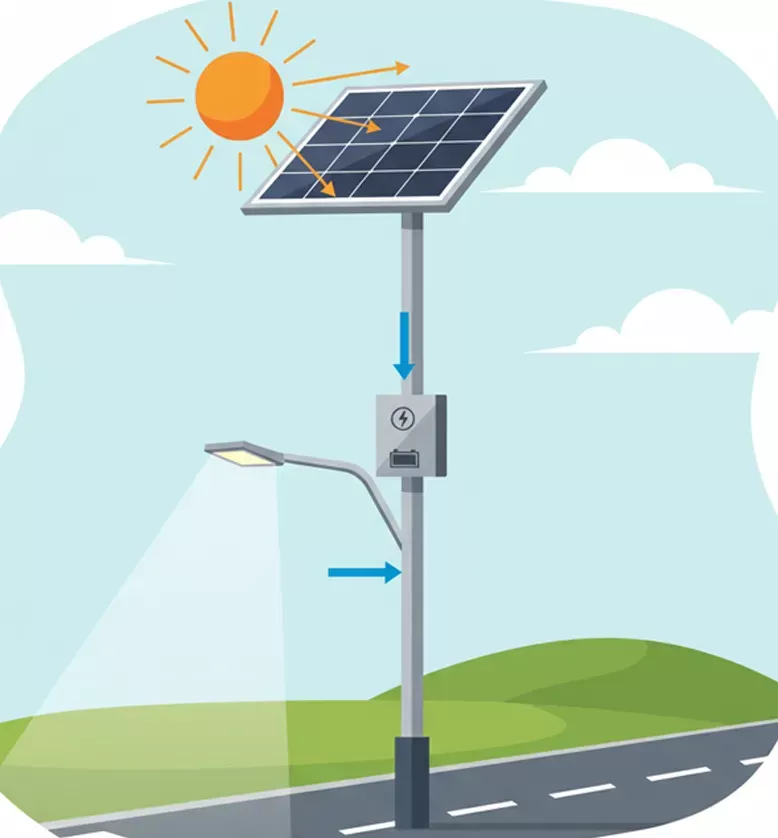
Solar panels: principle of photoelectric conversion
We all know that efficiency is the key to determining the popularity of technology. Solar panels are the embodiment of this 1 of efficiency. When sunlight falls on it, photons excite electrons in the semiconductor material, forming an electric current. This direct and pure photoelectric conversion eliminates many links of traditional energy power generation and fundamentally reduces energy loss. What I am more concerned about is that the increasing maturity of this conversion mechanism makes it possible to maintain a certain power generation efficiency even in a low-illumination environment, which is particularly important under the changing weather conditions of the city.
Energy storage battery: energy storage and release
The accumulation of energy during the day provides a guarantee for the lighting at night. The role of energy storage batteries is not simply “storage”, but more like a buffer in urban energy scheduling. It absorbs excess power and releases it precisely when needed. This allows solar street lights to provide stable and reliable lighting without external grid support. I believe that future breakthroughs in battery technology, such as solid-state batteries or higher energy density lithium-ion batteries, will further consolidate the independent operation of solar street lights.
LED light source: energy efficient lighting
Choosing LED as a light source is, in my opinion, a logical and forward-looking decision. The advantage of LEDs is their unparalleled energy efficiency. Compared with traditional high-pressure sodium lamps, LEDs can provide brighter and more uniform light at lower power consumption. This means that limited battery energy storage can support longer lighting, or under the same lighting duration, the battery capacity requirements are lower. In addition, the directional light emission characteristics of LEDs also reduce light pollution, which is an environmental indicator that urban planners are increasingly paying attention.
Intelligent controller: charge and discharge management, light control time control, human body induction, etc
In an intelligent solar street light, the controller acts as the brain of the complete system. It coordinates solar charging, battery discharging, lighting schedules, motion sensing, and protection functions to keep the system operating efficiently and safely.
Advantages of solar street lights
Battery Life and Recycling: Continuous Optimization under Technology Iteration
The promotion of early solar street lights did face the torture of battery life. The memory of the nickel-cadmium battery era is still fresh, and its charge and discharge times, capacity attenuation and later recycling were all pain points for project decision makers. But in just a few years, the rapid iteration of lithium-ion battery technology has completely changed this 1. Higher energy density, longer cycle life, and lower self-discharge rate. These advances have enabled the battery pack of modern solar street lights to operate stably for many years. At the same time, my attention to the green supply chain has also made me see that the battery recycling industry is becoming more and more mature. It has become an industry consensus to consider modular replacement and material recycling from the beginning of design. We are moving from “how to dispose of waste batteries” to “how to maximize the battery life cycle and effectively recycle their value”.
Extreme Weather Performance: The Fusion of Resilience and Intelligence
Urban lighting systems must withstand harsh environments, from summer heat to winter cold, from torrential rain to dust. In the past, questions about the endurance of solar street lights in cloudy, rainy and snowy weather were endless. However, this 1 a static and outdated view. Modern solar street light systems are far from a simple “panel battery” combination.
They are usually equipped with more efficient photovoltaic panels that can capture energy in low light conditions; more importantly, intelligent controllers and energy management systems can dynamically adjust according to weather forecasts and actual energy reserves, such as in the expected rainy days In the middle, the system will automatically optimize the discharge strategy to ensure that night lighting is not affected.
Towards a Sustainable Urban Lighting Future
The trend of solar street lights is irreversible. It is reshaping the landscape of urban lighting with its environmentally friendly, cost-effective and increasingly intelligent features. I am convinced that this is not a short-term trend, but a profound change in the logic of urban development. The installation of solar panel street lights is not only for our present, but also for a more sustainable and brighter urban future for future generations.

















 English
 français
 Español
 العربية
 Pilipino
 ไทย
ไทย tiếng việt
 Malay
Malay русский