An MPPT controller is responsible for managing solar-panel charging, battery protection, and lighting operation in a solar street light system. It helps the photovoltaic panel operate near its maximum available power point as sunlight and panel temperature change.
However, adding an MPPT controller cannot compensate for an undersized solar panel or battery. Reliable performance still depends on the complete system design, including LED power, operating hours, battery capacity, local solar conditions, and rainy-day autonomy.
For project buyers, the controller should be evaluated by its input voltage, charging current, battery compatibility, dimming functions, protection settings, and communication capabilities—not simply by the term “MPPT.”
What Is an MPPT Controller?
MPPT stands for Maximum Power Point Tracking.
The voltage and current generated by a solar panel change according to solar radiation, temperature, shading, and electrical load. The combination that produces the highest available power is called the maximum power point.
An MPPT controller continuously adjusts the electrical operating point of the solar panel so that more of the available photovoltaic energy can be converted into battery-charging power.
In a solar street light, the controller is normally installed between the solar panel, battery, and LED luminaire. It manages both daytime charging and nighttime lighting operation.
What Does an MPPT Controller Do?
An MPPT solar street light controller can perform several functions within one device:
Track the solar panel’s maximum available power
Convert panel voltage into suitable battery-charging voltage
Control battery charging current
Prevent battery overcharging
Disconnect or reduce the load at low battery voltage
Switch the LED light on at dusk
Switch the light off at dawn
Run programmed dimming schedules
Support motion-sensor control
Record system operating data
Report faults through a communication platform
The available functions depend on the controller model. Buyers should request a complete controller specification rather than accepting a quotation that only states “intelligent MPPT controller.”
MPPT vs PWM Controller
PWM and MPPT are two common solar charge-controller technologies.
A PWM controller connects the solar panel more directly to the battery and generally operates the panel near battery voltage. It is relatively simple and can be suitable for small systems in which the panel and battery voltages are closely matched.
An MPPT controller uses DC-to-DC conversion to operate the solar panel at a more suitable power-producing voltage while delivering the required charging voltage and current to the battery.
| Comparison Item | PWM Controller | MPPT Controller |
|---|
| Controller structure | Simpler | More advanced |
| Initial cost | Generally lower | Generally higher |
| Panel operating point | Near battery voltage | Tracks maximum power point |
| Voltage conversion | Limited | Supported |
| Panel configuration | More restricted | More flexible |
| Typical application | Small, closely matched systems | Medium- and high-power systems |
| Monitoring functions | Usually basic | Often more advanced |
Morningstar states that its MPPT controllers can increase solar-array energy harvest by approximately 5% to 30% compared with PWM controllers, depending on climate conditions and system design. This range should not be treated as a guaranteed improvement for every solar street light. Read Morningstar’s solar charge controller FAQ.
Why MPPT Is Useful for Solar Street Lights
Solar street lights must collect enough energy during the day to support the complete nighttime lighting schedule. Charging conditions may change continuously because of clouds, temperature, seasonal sunlight, and partial shading.
MPPT can be particularly useful when:
Solar-panel voltage is higher than battery voltage
The project uses a larger solar panel
Charging time is limited
Seasonal sunlight varies significantly
The panel and luminaire are installed separately
The system needs several rainy backup nights
A high-power LED luminaire is used
Remote operating data is required
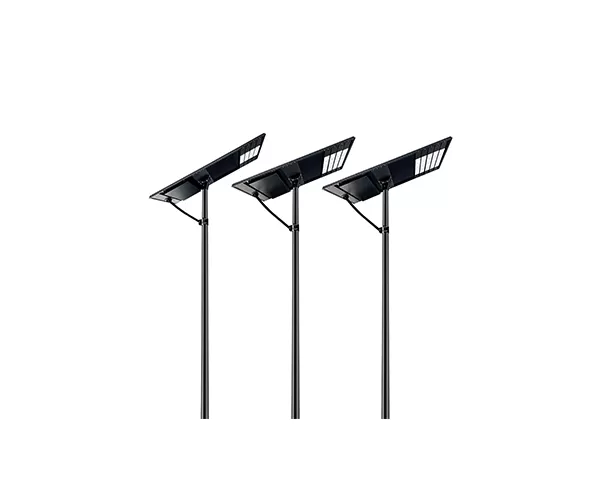
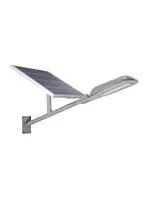
A solar panel street light with a separately mounted panel allows contractors to adjust the panel orientation without changing the direction of the luminaire. Inbrit’s all-in-two system places the battery inside the lamp body while installing the solar panel separately, providing greater flexibility in panel positioning.
How to Select the MPPT Controller Current
The controller’s rated charging current must be sufficient for the selected solar panel and battery system.
A simplified preliminary formula is:
Controller current ≈ Solar panel power ÷ battery charging voltage
For example, consider a 240W solar panel charging a nominal 24V battery system:
240W ÷ 24V = approximately 10A
This is only an initial estimate. The final controller selection must include design margins and the actual battery-charging voltage.
Buyers should verify:
Rated controller current
Maximum charging current
Solar-panel short-circuit current
Maximum PV input power
Battery-charging voltage
Required manufacturer safety margin
Selecting a controller with insufficient current capacity may limit charging or cause overheating and protection shutdowns.
Check the Maximum PV Input Voltage
The controller must also support the maximum voltage produced by the solar panel or panel array.
A panel’s open-circuit voltage can increase under cold conditions. Therefore, the maximum possible array voltage—not only the nominal operating voltage—must remain below the controller’s input limit.
Before approving the specification, compare:
Panel open-circuit voltage
Number of panels connected in series
Lowest expected site temperature
Controller maximum PV input voltage
MPPT operating-voltage range
Exceeding the maximum PV input voltage may damage the controller. Buyers should ask the supplier to show the voltage calculation in the technical proposal.
Match the Controller with the Battery
The MPPT controller must support the selected battery chemistry and voltage.
Common solar street light batteries include:
LiFePO4 batteries
Lithium-ion batteries
Gel batteries
AGM batteries
Lead-acid batteries
Each chemistry requires suitable charging-voltage limits, charging stages, temperature controls, and low-voltage disconnect settings.
For lithium batteries, the controller must also work correctly with the battery management system. The battery management system may disconnect charging or discharging when it detects overvoltage, undervoltage, overcurrent, or excessive temperature.
Battery capacity should be calculated before selecting the controller. See the related guide: How to Calculate Solar Street Light Battery Capacity.
MPPT Controllers in Different Solar Street Light Structures
All-in-One Systems
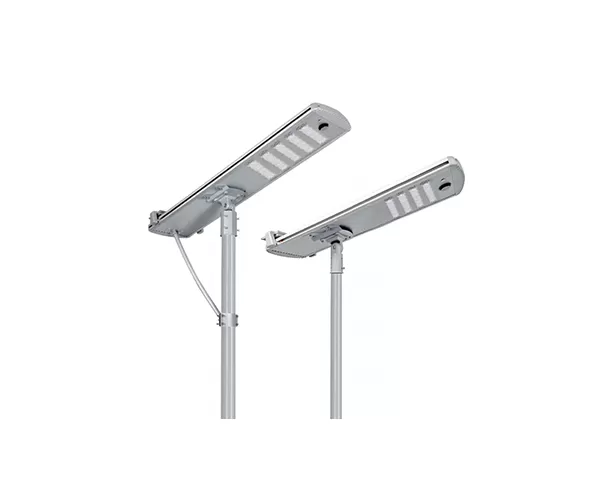
An all in one solar street light wholesale system integrates the solar panel, battery, controller, and LED luminaire into one compact product. Inbrit currently lists all-in-one configurations from 10W to 80W, with operating schedules that can be preset before delivery.
The integrated controller should be correctly matched at the factory because changing the panel or battery later may be more difficult.
All-in-Two Systems
All-in-two systems separate the solar panel from the luminaire and battery. This allows more flexible panel orientation while keeping most of the control and storage equipment integrated into the light.
The MPPT input range must match the independently installed panel and the cable distance between the panel and luminaire.
Split Systems
A split solar street light separates the solar panel, battery, controller, and luminaire. This structure provides greater flexibility for high-power panels, larger batteries, and individual component maintenance.

Split systems may require additional attention to cable sizing, waterproof connectors, enclosure protection, and voltage drop.
Can MPPT Improve Rainy-Day Performance?
MPPT can improve the use of the solar energy that remains available during cloudy conditions. However, it cannot create electricity when sunlight is unavailable.
Rainy-day operation still depends on:
Solar-panel wattage
Battery usable capacity
Nightly LED energy demand
Dimming schedule
Required autonomy
Seasonal solar irradiation
Recovery charging after bad weather
A system with an MPPT controller can still fail during prolonged poor weather if its battery or panel is undersized.
The complete design process is explained in the related article: Rainy Day Autonomy Design for Solar Street Lights.
MPPT Controller Procurement Checklist
Before ordering, confirm the following information:
Controller manufacturer and model
MPPT operating-voltage range
Maximum PV input voltage
Maximum charging current
Supported battery voltage
Supported battery chemistry
Charging-voltage settings
Low-voltage disconnect setting
Overcharge and over-discharge protection
Reverse-polarity protection
Temperature compensation
Lighting and dimming programs
Motion-sensor compatibility
Communication and monitoring functions
Controller IP rating and installation position
The quotation should clearly show how the controller matches the solar panel, battery, and LED load.
FAQ
Does an MPPT Controller Make a Solar Street Light Brighter?
Not directly. The controller improves solar charging and manages battery energy. Brightness mainly depends on LED power, lumen output, optical design, and the programmed lighting mode.
Is MPPT Always Better Than PWM?
MPPT generally provides greater charging flexibility, especially in larger systems or where panel voltage is higher than battery voltage. PWM may still be suitable for small and closely matched systems.
Can an MPPT Controller Charge a Lithium Battery?
Yes, provided that the controller supports the correct lithium chemistry, charging voltage, battery-management requirements, and temperature limits.
Does MPPT Increase Battery Capacity?
No. MPPT may improve the amount of energy collected from the solar panel, but it does not increase the battery’s physical storage capacity.
Can a Larger Solar Panel Be Connected to Any MPPT Controller?
No. The panel’s maximum power, open-circuit voltage, short-circuit current, and operating voltage must remain within the controller’s specified limits.
Conclusion
An MPPT controller helps a solar street light collect available photovoltaic energy, charge the battery correctly, protect system components, and manage nighttime lighting schedules.
Buyers should evaluate the controller’s current rating, PV input voltage, battery compatibility, protection settings, dimming functions, and communication capabilities. MPPT can improve charging performance, but it must be combined with a correctly sized solar panel, battery, LED load, and rainy-day autonomy design.



 English
 français
 Español
 العربية
 Pilipino
 ไทย
ไทย tiếng việt
 Malay
Malay русский