Battery capacity determines whether a solar street light can complete its nightly lighting schedule and continue operating during cloudy or rainy weather. If the battery is too small, the light may dim early, switch off before sunrise, or experience frequent deep discharge. If it is unnecessarily large, the system cost, weight, and solar panel requirements will increase.
For project buyers, battery sizing should not be based only on LED wattage. A reliable calculation must consider operating hours, dimming schedules, system losses, battery voltage, depth of discharge, local temperature, and required rainy-day autonomy.
Step 1: Calculate the Daily Lighting Load
The first step is to calculate how much electrical energy the LED luminaire consumes each night.
The basic formula is:
Daily lighting load (Wh) = LED power (W) × operating hours (h)
For example, a 40W street light operating at full brightness for 12 hours would consume:
40W × 12h = 480Wh per night
However, many solar street lights use programmed dimming rather than operating at full power throughout the night.
For example:
40W at 100% brightness for 4 hours: 160Wh
40W at 50% brightness for 4 hours: 80Wh
40W at 25% brightness for 4 hours: 40Wh
The total daily lighting load would be:
160Wh + 80Wh + 40Wh = 280Wh
Using the actual lighting schedule produces a more accurate result than calculating battery capacity from the rated LED wattage alone.
Step 2: Include System Energy Losses
Not all the energy stored in the battery reaches the LED module. Some energy is lost through the controller, LED driver, battery discharge process, wiring, and electrical connections.
A simplified calculation is:
Adjusted energy demand = Daily lighting load ÷ system efficiency
If the daily lighting load is 280Wh and the estimated discharge efficiency is 90%:
280Wh ÷ 0.90 = approximately 311Wh
The efficiency value should be based on the actual controller, battery, and LED driver specifications whenever possible.
The system should also include low-voltage disconnect protection. This function switches off or reduces the load before the battery reaches an unsafe discharge level. The National Renewable Energy Laboratory identifies low-voltage disconnect settings as an important part of battery protection in standalone photovoltaic systems.
Step 3: Determine the Required Rainy-Day Autonomy
Rainy-day autonomy refers to how long the solar street light should continue operating when the solar panel provides little or no useful charging energy.
The formula is:
Required usable battery energy = Adjusted daily energy × autonomy days
If the adjusted daily demand is 311Wh and the project requires three nights of backup:
311Wh × 3 days = 933Wh
The correct autonomy requirement depends on:
Seasonal weather conditions
Lowest monthly solar irradiation
Road safety requirements
Acceptable dimming during bad weather
Availability of maintenance teams
Project budget
A residential pathway may require less backup capacity than a municipal road, industrial entrance, or remote public facility.
Step 4: Account for Battery Depth of Discharge
The full nominal capacity of a battery should not normally be treated as usable energy.
Depth of discharge indicates how much of the battery’s nominal capacity can be used before recharging. The allowable value depends on battery chemistry, battery management settings, temperature, and the manufacturer’s recommendations.
The simplified calculation is:
Nominal battery energy = Required usable energy ÷ allowable depth of discharge
If the project requires 933Wh of usable energy and the design permits an 80% depth of discharge:
933Wh ÷ 0.80 = approximately 1,166Wh
The system would therefore require at least approximately 1,166Wh of nominal battery storage before additional allowances for temperature and long-term capacity decline.
A lithium battery solar street light often uses LiFePO4 batteries because they can support compact system designs and controlled charging cycles. However, buyers should still verify the nominal voltage, ampere-hour rating, watt-hour capacity, protection settings, and expected operating temperature.

Step 5: Convert Watt-Hours into Ampere-Hours
Battery specifications are commonly expressed in ampere-hours, while the lighting demand is usually calculated in watt-hours.
The conversion formula is:
Battery capacity (Ah) = Battery energy (Wh) ÷ nominal battery voltage (V)
For a 12.8V battery:
1,166Wh ÷ 12.8V = approximately 91Ah
The preliminary battery specification would therefore be approximately:
12.8V, 91Ah
In actual product selection, the manufacturer may use the nearest available standard battery size and apply additional capacity margins.
A 25.6V battery system would require fewer ampere-hours for the same total watt-hour capacity:
1,166Wh ÷ 25.6V = approximately 46Ah
This is why buyers should not compare batteries only by ampere-hours. Battery voltage and watt-hours must also be considered.
Step 6: Consider Temperature and Battery Aging
Battery performance changes with temperature. Cold conditions can reduce the usable energy available before the low-voltage protection activates. High temperatures may also accelerate battery aging.
The battery design should consider:
Lowest expected battery temperature
Battery enclosure ventilation
Direct exposure to sunlight
Battery management system settings
Capacity reduction over time
Required performance near the end of service life
A system designed only for ideal laboratory conditions may not provide the expected operating time after several years in an outdoor environment.
For projects in cold, tropical, coastal, or desert regions, buyers should request confirmation that the battery and enclosure are suitable for the actual climate.
Step 7: Match the Battery with the Solar Panel
A large battery does not guarantee reliable operation if the solar panel cannot recharge it.
The solar panel must generate enough daily energy to:
Supply the previous night’s consumption
Compensate for charging losses
Restore energy used during rainy periods
Recharge the battery within an acceptable recovery period
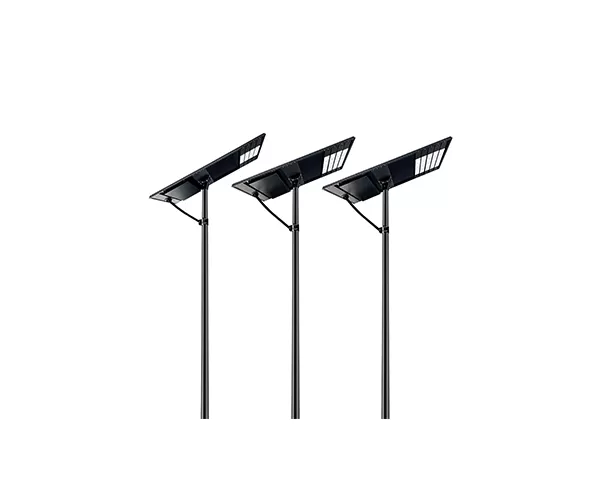
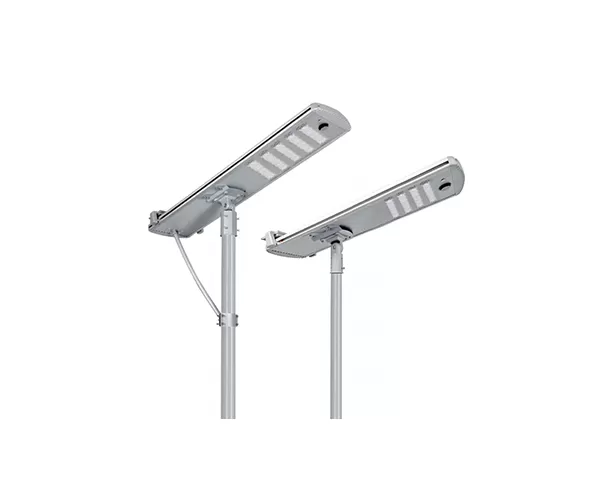
A solar street light with panel and battery allows the solar panel to be installed separately from the lighting body. This gives contractors greater flexibility to adjust the panel direction and tilt angle for better sunlight exposure.
The solar panel should be sized according to:
The installation city or GPS coordinates should be provided when requesting a system calculation.
Example Battery Capacity Calculation
Consider the following project:
| Design Item | Project Requirement |
|---|
| LED rated power | 60W |
| Full-power operation | 4 hours |
| 50% operation | 4 hours |
| 25% operation | 4 hours |
| System efficiency | 90% |
| Required autonomy | 3 nights |
| Allowable depth of discharge | 80% |
| Battery voltage | 12.8V |
Nightly LED consumption:
60W × 4 hours = 240Wh
30W × 4 hours = 120Wh
15W × 4 hours = 60Wh
Total LED consumption = 420Wh
After system losses:
420Wh ÷ 0.90 = approximately 467Wh
For three nights:
467Wh × 3 = approximately 1,401Wh usable energy
After accounting for 80% depth of discharge:
1,401Wh ÷ 0.80 = approximately 1,751Wh nominal energy
Convert to ampere-hours:
1,751Wh ÷ 12.8V = approximately 137Ah
The preliminary requirement would therefore be approximately 12.8V and 137Ah, before applying temperature, aging, and project safety margins.
Battery Specification Checklist for Buyers
When reviewing a solar street light with pole and battery quotation, buyers should confirm:
Battery chemistry
Nominal battery voltage
Ampere-hour capacity
Total watt-hour capacity
Allowable depth of discharge
Lighting and dimming schedule
Required autonomy days
Low-voltage disconnect setting
Minimum and maximum operating temperature
Solar panel wattage
Expected charging recovery time
Battery warranty conditions
A quotation that only states “lithium battery” without detailed voltage, capacity, and operating assumptions is not sufficient for technical comparison.
FAQ
Can Solar Street Light Battery Capacity Be Calculated from Wattage Alone?
No. The calculation must also include operating hours, dimming schedules, system losses, autonomy days, battery voltage, allowable depth of discharge, and temperature conditions.
Should Buyers Compare Batteries by Ah or Wh?
Watt-hours provide a more useful comparison because they include both battery voltage and ampere-hour capacity. Ampere-hours should never be evaluated without the nominal voltage.
Does a Larger Battery Provide More Rainy-Day Autonomy?
A larger usable battery capacity can extend autonomy, but only if the solar panel can recharge it effectively. Battery and panel sizing must be calculated together.
Why Does Dimming Reduce the Required Battery Capacity?
Dimming lowers the LED’s energy consumption during low-traffic periods. A lower nightly energy load reduces the amount of battery storage required for the same number of operating nights.
Can an MPPT Controller Replace a Larger Battery?
No. An MPPT controller can improve the collection of available solar energy, but it does not increase the battery’s physical storage capacity.
Conclusion
Solar street light battery capacity should be calculated from the actual nightly energy requirement rather than the advertised LED wattage alone. Operating hours, dimming schedules, system losses, rainy-day autonomy, depth of discharge, temperature, and battery aging all influence the final specification.
Buyers should request a transparent energy calculation showing how the battery matches the LED load, solar panel, controller, and local weather conditions. This helps prevent both undersized systems that fail during bad weather and oversized systems that add unnecessary project cost.








 English
 français
 Español
 العربية
 Pilipino
 ไทย
ไทย tiếng việt
 Malay
Malay русский