Lighting a large, open site from only a few mounting points requires more than increasing fixture wattage. The pole structure, luminaire arrangement, foundation interface, lightning protection, and delivery method must function as a single engineered system. For this project, Inbrit produced a batch of several customized 35m high mast light pole systems designed to provide broad, reliable illumination in a demanding outdoor environment.
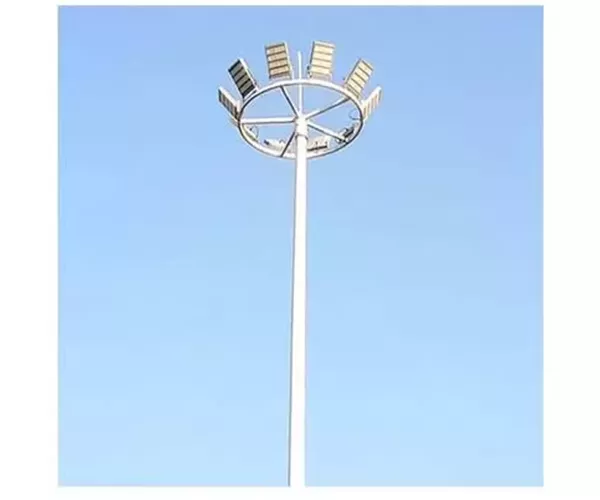
Each mast combines four tapered steel sections with wall thicknesses of 12mm, 10mm, 8mm, and 6mm from bottom to top. A circular headframe carries eight 400W LED luminaires, giving each pole 3,200W of installed lighting power. A dedicated lightning rod, protective rain covers, and a hot-dip galvanized and powder-coated finish help the system withstand long-term outdoor exposure.
35m High Mast Light Pole Project at a Glance
| Project quantity | 12 high mast lighting systems |
|---|
| Pole height | 35m |
|---|
| Mast structure | Four tapered steel sections |
|---|
| Section wall thickness | 12mm, 10mm, 8mm and 6mm from base to top |
|---|
| LED configuration | Eight 400W LED luminaires per mast |
|---|
| Total LED power | 3,200W per mast |
|---|
| Headframe diameter | Approximately 3.5m |
|---|
| Outdoor protection | Dedicated lightning rod and heavy-duty rain covers |
|---|
| Surface treatment | Hot-dip galvanizing followed by powder coating |
|---|
| Auxiliary integration | Four support arms reserved for monitoring equipment |
|---|
The Project Challenge: Covering a Large, Exposed Site
Large industrial yards, logistics areas, transport facilities, and other open sites can be difficult to illuminate efficiently. Numerous short poles may increase trenching, cabling, foundation work, and maintenance points. A high-mast system places multiple luminaires at a higher height, allowing a single lighting point to cover a much wider area.
Height alone, however, does not guarantee a successful result. At 35m, the mast must support the dead load of the headframe and luminaires while also responding to wind-induced forces and vibration. The lighting arrangement must distribute output beyond the immediate base of the pole, and the components must be practical to manufacture, transport, assemble, and maintain.
The project, therefore, required a custom light pole solution rather than a standard catalog pole. Inbrit developed the mast configuration around the required installation height, lighting load, and site conditions, then translated the design into a segmented structure suitable for production and delivery.
A Four-Section Tapered Mast Designed Around Structural Demand
The 35m pole is divided into four sturdy sections. The lower section uses a 12mm wall to provide strength where the structural demand is greatest. The wall thickness then changes to 10mm, 8mm, and 6mm toward the top. This progressive configuration places more steel near the base while avoiding unnecessary weight at the mast's upper end.
Segmenting the pole also makes a structure of this scale more manageable during manufacturing, loading, transport, and site erection. The engineering drawing defines the overall assembly, section transitions, headframe interface, base connection, and auxiliary brackets so that the individual components can be coordinated before shipment.
For a high-mast project, these dimensions cannot be selected based on height alone. A qualified light pole manufacturer must also consider the luminaire and headframe load, local design wind speed, foundation and anchor arrangement, soil conditions, and any additional equipment mounted on the mast. These inputs should be confirmed before the final structural drawing is approved.
Eight 400W LED Lights for 360-Degree Site Coverage
Each pole carries eight high-power 400W LED luminaires on a circular headframe approximately 3.5m in diameter. Together, the fixtures provide 3.2kW of installed LED lighting power per mast. Arranging the luminaires around the frame allows light to be directed into multiple zones rather than concentrating it in a single direction.
This configuration was selected to illuminate the broader working area and reach the edges and corners of the site from a high mounting position. The circular layout also gives the project team flexibility to aim individual luminaires according to the final lighting plan.
Fixture wattage is only one part of high mast lighting design. When comparing high mast light suppliers, buyers should also evaluate beam angle, mounting orientation, target illuminance, uniformity, glare control, and surrounding obstructions through a project-specific photometric layout. This helps confirm the number of poles and luminaires required before civil work begins.
Lightning, Rain, and Corrosion Protection for Outdoor Operation
A tall metal mast is continuously exposed to rain, wind and atmospheric contaminants. The project design, therefore, includes a dedicated lightning rod above the luminaire frame and heavy-duty rain covers around critical upper components. These measures help reduce weather-related risk and protect the lighting assembly in an exposed installation.
The manufacturing drawing also specifies hot-dip galvanizing followed by powder coating. Galvanizing protects the underlying steel, while the coated exterior provides an additional barrier and the required finished appearance. For coastal, chemically aggressive or unusually humid locations, buyers should provide environmental information during the design stage so that the surface treatment can be reviewed against the actual site conditions.
Prepared for Monitoring Equipment as Well as Lighting
In addition to the lighting headframe, the project drawing includes four support arms for monitoring equipment. Integrating these provisions during the pole design stage is preferable to adding unverified brackets after installation. The additional equipment changes the projected wind area, cable routing and total structural load, so it should be included in the original engineering review.
This detail shows how a high-mast light pole can serve as a coordinated infrastructure point rather than merely a luminaire support. Depending on the project, similar custom provisions may be developed for cameras, communication devices or other approved equipment.
Segmented Production and Protected Delivery
The project documentation specifies the mast batch. Before delivery, the separate pole sections and base assemblies were grouped and protected for transport. A sectional design helps long components fit the logistics plan while allowing each mast to be assembled to its full 35m height at the destination.
For oversized light-pole shipments, careful preparation is essential. Sections should be identified for matching, coated surfaces should be protected against handling damage, and lifting points and unloading requirements should be coordinated before the truck reaches the site. Foundation work, anchor placement and erection equipment should also be ready so installation can proceed in the correct sequence.
What This Case Means for Buyers Comparing Light Pole Manufacturers
A 35m high mast is not simply a taller version of a standard street pole. It requires project-specific coordination between structural design, lighting performance, foundation engineering, corrosion protection, production and logistics. Buyers evaluating a light pole manufacturer should therefore review the supplier's ability to work from project data and produce coordinated drawings, rather than just compare unit prices.
Before requesting a proposal, prepare the following information:
Site plan, dimensions and intended application
Required mounting height and preferred number of poles
Target illuminance and uniformity
Available power supply and control requirements
Local design wind speed and environmental conditions
Luminaire, headframe and auxiliary equipment loads
Geotechnical or foundation information, if available
Required coating, color, maintenance method and project standards
With these inputs, Inbrit can develop a configuration around the actual application, including mast height, section structure, lighting arrangement and installation requirements.
High Mast Poles and Solar Street Light Poles Serve Different Projects
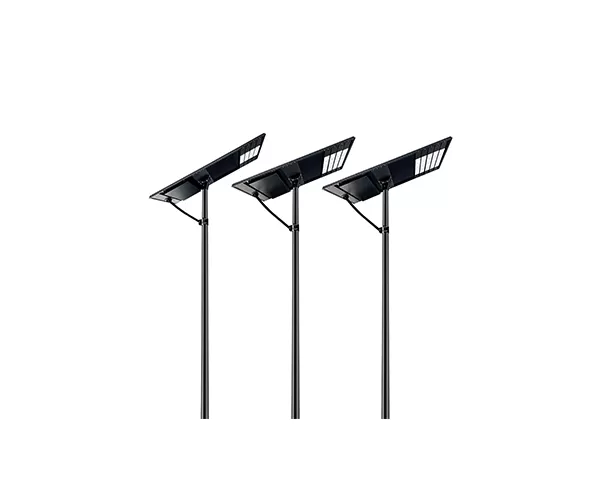
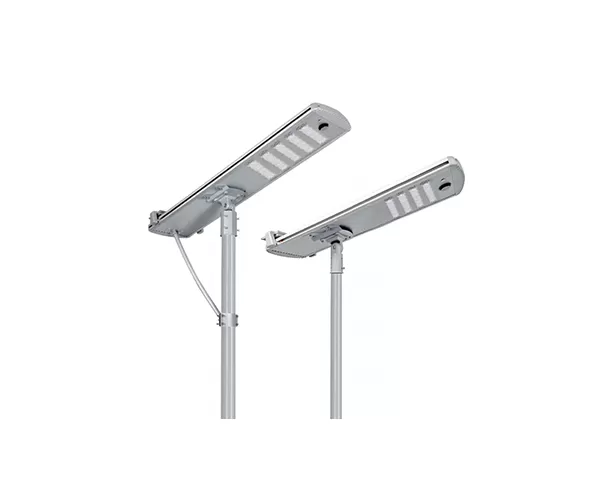
Inbrit manufactures both high mast systems and solar street light poles, but they should not be treated as interchangeable products. Solar street poles are commonly used for roads and off-grid lighting with a solar panel, battery and LED fixture, while a high mast pole typically supports multiple high-output luminaires for wide-area coverage.
This 35m case is a high mast LED lighting project with eight 400W fixtures per pole. No solar power system is shown in the supplied project drawing, so the power configuration should not be described as solar. For projects where grid access is limited, solar or hybrid options must be evaluated separately according to the required lighting load, operating hours and local solar resource.
Frequently Asked Questions
How many LED lights can be installed on a 35m high mast pole?
The number depends on the target light level, fixture output, headframe capacity and wind-load design. This project uses eight 400W LED luminaires, providing 3.2kW of installed lighting power per pole.
Why is a 35m light pole divided into sections?
A sectional mast is easier to manufacture, transport and erect than a single 35m component. Its connections and overlap details must be engineered for the specific pole configuration.
What is the difference between a high mast pole and solar street light poles?
A high mast pole is generally used for wide-area lighting with multiple luminaires at a greater height. Solar street light poles usually support an individual solar panel, battery and LED fixture for road or off-grid applications.
What information is needed to quote a custom high mast light pole?
Provide the pole height, site plan, target lighting level, local wind speed, fixture and equipment loads, power supply, corrosion environment and applicable engineering standards.
Can monitoring equipment be added to a high mast light pole?
Yes, if it is included in the structural and electrical design. This project reserves four monitoring support arms so the additional load and wind area can be considered before production.
Plan Your High Mast Lighting Project with Inbrit
This 35m project demonstrates how structural strength, wide-area LED distribution, outdoor protection and transport planning come together in one customized high mast lighting system. The four-section mast, eight 400W luminaires, lightning protection and project-specific auxiliary brackets were coordinated to meet the needs of a large outdoor site.
If you are planning lighting for an industrial yard, logistics hub, port, airport, sports facility, large intersection or other open area, send Inbrit your site plan and technical requirements. Our team can help you evaluate the appropriate light pole height, structural configuration and luminaire arrangement for your project.

 English
 français
 Español
 العربية
 Pilipino
 ไทย
ไทย tiếng việt
 Malay
Malay русский