What Buyers Should Check Before Importing Solar Street Lights
Importing solar street lights involves more than comparing product wattage and unit price. Buyers must verify the lighting performance, solar panel and battery sizing, pole structure, certificates, quality-control procedures, packaging, shipping terms, customs documents, warranty, and replacement-part support.
A product may look competitive in a quotation but become expensive after freight, duties, installation accessories, testing, damaged packaging, or premature battery replacement are included.
Before selecting a solar street light manufacturer, importers should establish clear technical specifications and require each supplier to quote under the same project conditions.
Confirm the Project Requirements Before Requesting Prices
A supplier cannot prepare an accurate configuration without knowing where and how the lights will be used. Generic requests, such as “send your 100W solar street light price,” often yield quotations that cannot be fairly compared.
Buyers should provide:
Installation country, city, or coordinates
Road width and total project length
Required pole height and spacing
Nightly operating hours
Full-power and dimming requirements
Required cloudy or rainy backup nights
Local temperature range
Design wind speed
Estimated order quantity
Required delivery date
The supplier should use this information to prepare the luminaire, solar panel, battery, controller, pole, foundation, and lighting schedule as one complete system.
Verify the Product Configuration
The quotation should clearly identify every major component. Buyers should avoid descriptions that list only nominal wattage, battery ampere-hours, and solar panel power.
| Component | Information to Verify |
|---|
| LED luminaire | Actual power, lumen output, efficacy, optics, color temperature, and dimming profile |
| Solar panel | Rated power, voltage, dimensions, cell type, efficiency, and warranty |
| Battery | Chemistry, voltage, Ah, Wh, usable capacity, cycle conditions, and protection system |
| Controller | MPPT or PWM, charging current, dimming periods, protection, sensing, and communication |
| Pole | Height, steel grade, thickness, diameters, flange, anchors, galvanizing, and wind design |
| Accessories | Brackets, bolts, cables, connectors, templates, enclosures, and installation hardware |
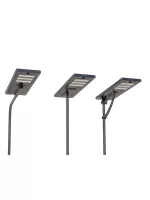
When importing an all in one solar street light wholesale order, buyers should confirm whether the battery and controller can be replaced independently. A fully integrated housing can simplify installation, but future maintenance access remains important.
Check Battery Capacity in Watt-Hours
Battery capacity should be compared in watt-hours rather than ampere-hours alone.
Battery energy in Wh = Battery voltage × Battery capacity in Ah
For example:
12.8V × 80Ah = 1,024Wh
A 12.8V 80Ah battery and a 25.6V 80Ah battery do not store the same amount of energy. Buyers should also ask how much of the nominal capacity is usable after the battery-management system, depth-of-discharge limit, temperature correction, and aging allowance are considered.
The supplier should disclose whether the advertised rainy-day autonomy is based on full brightness or reduced output.
Request a Complete Nighttime Lighting Profile
A specification stating “12 hours per night” does not explain how much light is delivered during those hours.
A complete schedule may look like this:
| Nighttime Period | Brightness | Operating Duration |
|---|
| Early evening | 100% | 4 hours |
| Late evening | 60% | 4 hours |
| Low-traffic period | 30% | 4 hours |
Importers should compare competing products using the same hourly lighting profile. A system running at 30% output for most of the night should not be compared directly with one providing higher output for a longer period.
Verify Photometric Performance
LED wattage does not indicate whether the luminaire will properly illuminate the target road. Buyers should request an IES or LDT photometric file and a lighting calculation based on the proposed road layout.
The calculation should show:
Pole locations
Mounting height
Pole spacing
Road width
Average illuminance
Minimum illuminance
Uniformity
Luminaire tilt angle
Claims such as “covers 30 meters” or “suitable for highways” are not sufficient without a defined road width, pole arrangement, optics, and lighting target.
Review Pole and Foundation Specifications
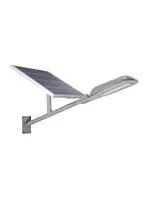
The solar panel creates an additional wind-exposed area, so the pole should be designed for the complete equipment configuration.
A complete solar street light with pole quotation should include:
Pole height and structural shape
Steel grade and wall thickness
Top and bottom diameter
Lamp-arm dimensions
Solar panel dimensions and tilt angle
Base-plate dimensions
Anchor-bolt diameter and length
Design wind speed
Galvanizing or coating standard
Foundation reference drawing
The final foundation should be reviewed according to the project’s soil conditions and local structural requirements.

Check Certificates and Test Reports
Required certificates vary by destination market, tender, product structure, and importer responsibilities. Buyers should identify the applicable requirements before production begins.
Documents may include:
Electrical safety test reports
Electromagnetic compatibility reports
Ingress-protection test reports
Photometric reports and IES files
Battery safety and transport documents
Solar panel test documents
Material certificates
Galvanizing inspection reports
Structural calculations
Quality-management certificates
Check whether each report covers the exact model, wattage, battery, controller, and production configuration being purchased. A certificate for a similar product does not automatically cover the offered system.
Arrange Pre-Shipment Quality Inspection
Quality checks should be agreed upon before the deposit is paid. Buyers should define the inspection method, sample quantity, acceptance criteria, and corrective-action process.
Pre-shipment inspection may include:
Product dimensions and appearance
LED power and functional testing
Battery voltage and capacity records
Solar panel rated-power verification
Controller programming
Motion-sensor testing
Communication testing for smart systems
Pole dimensions and coating thickness
Accessory quantity
Packaging and shipping marks
A smart solar street light order should also be tested for device identification, platform login, remote commands, alarm reporting, gateway operation, and local operation during communication failure.
Clarify Incoterms and Shipping Responsibilities
The quotation should identify the agreed Incoterms rule and named location. Incoterms define how transportation tasks, costs, and risks are divided between the seller and buyer.
The U.S. International Trade Administration explains that Incoterms consist of 11 internationally recognized rules covering responsibilities such as shipment, insurance, documentation, and customs clearance. Buyers can review its official Incoterms guidance.
Before confirming the order, clarify:
Factory pickup or port delivery point
Export customs-clearance responsibility
Ocean or air freight
Cargo insurance
Destination-port charges
Import customs clearance
Duties and taxes
Final delivery to the project site
FOB, CIF, DAP, and DDP quotations should not be compared without checking which costs and risks are included.
Prepare Customs and Import Documents
Import requirements vary by destination country. Buyers should consult a customs broker or local authority before shipping.
Common documents include:
Commercial invoice
Packing list
Bill of lading or airway bill
Certificate of origin, where required
Product certificates and test reports
Battery transport documentation
Insurance certificate where applicable
Import permit where required
U.S. Customs and Border Protection advises importers to understand customs policies and procedures before importing. CBP also states that “the importer is ultimately responsible for paying any duty owed on an import.” Buyers entering the United States can review the CBP importing guidance.
Check Packaging and Container Loading
Solar panels, poles, batteries, luminaires, and brackets require different packaging methods. Poor packaging can cause cracked panel glass, bent brackets, scratched coatings, damaged connectors, or missing accessories.
Buyers should request:
Packaging photos or drawings
Carton and crate dimensions
Gross and net weight
Container-loading quantity
Protection between galvanized poles
Battery packing and transport labels
Accessory identification
Shipping marks and pallet details
Long poles may require sectional designs or specific container types. These requirements should be confirmed before production.
Confirm Warranty, Spare Parts, and Claims Procedures
A warranty should identify what is covered, when the warranty begins, and how claims are handled.
Confirm:
Warranty period for each component
Battery-capacity warranty conditions
Required claim evidence
Replacement-part shipping responsibility
Technical response time
Availability of controllers, batteries, drivers, sensors, and connectors
Recommended spare-parts ratio
For large projects, ordering spare controllers, LED drivers, connectors, sensors, and communication modules with the initial shipment can reduce future downtime.
Solar Street Light Import Checklist
Define the application and installation coordinates.
Confirm the exact lighting profile.
Compare batteries in watt-hours and usable energy.
Request photometric and energy calculations.
Review pole, wind-load, and foundation information.
Verify model-specific certificates and reports.
Approve a sample before mass production.
Agree on inspection and acceptance criteria.
Confirm Incoterms and total landed cost.
Prepare customs and battery transport documents.
Approve packaging and container loading.
Confirm warranty, spare parts, and claim procedures.
FAQ
Should Buyers Import Samples Before Placing a Bulk Order?
Yes. A sample allows buyers to inspect the structure, components, lighting output, controller functions, assembly process, packaging, and documentation before approving mass production.
Which Incoterm Is Best for Solar Street Light Imports?
There is no universal best term. The right choice depends on the buyer’s freight experience, customs capability, destination, insurance requirements, and desired level of control.
Can One Certificate Cover Every Solar Street Light Model?
Not necessarily. Buyers should confirm that the report covers the exact model, wattage, component configuration, and applicable destination-market requirements.
How Should Buyers Compare Supplier Prices?
Compare the complete landed and lifecycle cost, including equipment, poles, foundations, accessories, freight, duties, installation, warranty, batteries, software, and spare parts.
What Should Be Checked Before Paying the Final Balance?
Review the pre-shipment inspection results, quantities, controller settings, certificates, packing list, packaging photos, shipping marks, warranty documents, and corrective actions for any identified defects.
Conclusion
Importing solar street lights requires coordinated technical, commercial, logistics, and compliance planning. A low unit price cannot compensate for an undersized battery, unsuitable optics, weak pole, incomplete certificates, damaged packaging, or unclear warranty responsibilities.
Buyers should use one standardized specification to compare suppliers, approve samples before production, conduct pre-shipment inspections, and calculate the total landed cost before placing an order.
A clear procurement process helps importers receive solar street lights that match the project’s lighting, energy, structural, installation, and maintenance requirements.

 English
 français
 Español
 العربية
 Pilipino
 ไทย
ไทย tiếng việt
 Malay
Malay русский