A solar street light specification sheet may contain dozens of technical values, including LED wattage, lumen output, solar panel power, battery capacity, controller type, operating hours, pole height, ingress protection, and rainy-day autonomy.
These values should not be reviewed independently. A large battery does not guarantee long operating time if the LED load is high, while a high-wattage solar panel cannot provide reliable charging if it is installed in a shaded location or sized for annual-average sunlight.
Contractors, distributors, municipal buyers, and project developers should read the specification as one complete energy, lighting, structural, and control system. This guide explains the main values buyers should verify before comparing quotations.
Start with the Actual LED Power
LED power is normally stated in watts. It indicates the electrical power consumed by the LED module under specified operating conditions, but it does not directly describe how much useful light reaches the road.
When reviewing a specification, confirm:
Actual LED operating power
Maximum LED module power
Power at each programmed dimming level
LED driver efficiency
Whether wattage refers to the luminaire or only the LED chips
Whether the light operates at full power throughout the night
A solar street light 100w may operate at 100% output during the first few hours and then reduce its power later in the night. Buyers should request the complete hourly operating schedule rather than assuming that the luminaire consumes 100W for the entire lighting period.
Compare Lumens, Not Wattage Alone
Lumen output describes the total quantity of visible light produced by the luminaire. Luminous efficacy indicates how efficiently the luminaire converts electrical power into light and is generally expressed in lumens per watt.
The basic relationship is:
Luminous efficacy = Luminaire lumen output ÷ Input power
For example, a 60W luminaire producing 9,000 lumens has an efficacy of:
9,000 lm ÷ 60W = 150 lm/W
Buyers should distinguish between LED-chip efficacy and complete-luminaire efficacy. Optical lenses, heat management, drivers, protective covers, and internal electrical losses can reduce the output of the finished luminaire.
The U.S. Department of Energy’s Model Specification for LED Roadway Luminaires is designed to help municipalities and utilities prepare performance-based procurement documents for roadway lighting products.
Check the Photometric Distribution
Total lumens do not show where the light is directed. A street light must distribute illumination across the road, sidewalk, parking area, or project zone instead of concentrating most of the output directly below the pole.
Important photometric information includes:
The supplier should prepare a lighting simulation based on the proposed pole height, pole spacing, road width, mounting angle, and luminaire model. A generic statement such as “covers 30 meters” is not a substitute for a photometric layout.
Understand the Solar Panel Specification
The solar panel provides the daily energy required to recharge the battery. Its rated wattage is normally measured under standardized test conditions, while actual outdoor production changes according to sunlight, temperature, shading, orientation, dust, and system losses.
Buyers should confirm:
Rated maximum power in watts
Panel type and cell technology
Operating voltage and current
Open-circuit voltage
Short-circuit current
Panel dimensions and weight
Conversion efficiency
Required orientation and tilt angle
Product and performance warranty
The panel must be matched with the battery voltage and controller input range. An oversized wattage claim is not useful if the controller cannot accept the panel voltage or if the installation position receives several hours of daily shade.
Read Battery Capacity in Watt-Hours
Battery capacity is often listed in ampere-hours, but ampere-hours cannot be compared without considering voltage.
The basic conversion is:
Battery energy in Wh = Battery voltage × Battery capacity in Ah
For example:
12.8V × 100Ah = 1,280Wh
Two batteries rated at 100Ah may store different amounts of energy if their nominal voltages are different.
Buyers should request:
Battery chemistry
Nominal voltage
Ampere-hour capacity
Watt-hour capacity
Allowable depth of discharge
Cycle-life test conditions
Operating-temperature range
Battery-management-system functions
Low-voltage protection setting
Warranty conditions
The usable battery energy is lower than the nominal value because the controller should prevent excessive discharge. Temperature, aging, charging efficiency, and cable losses also affect the energy available to the LED.
Verify the Controller Type and Functions
The solar controller manages panel charging, battery protection, LED switching, dimming, and optional communication functions.
A smart solar street light may use an MPPT controller with time-based dimming, battery protection, motion sensing, operating-data collection, and remote management.

Controller specifications should state:
PWM or MPPT charging method
System voltage
Maximum panel input voltage
Maximum charging current
LED output current
Programmable time periods
Dimming range
Motion-sensor functions
Low-voltage disconnect level
Overcharge and overtemperature protection
Communication method where applicable
Buyers should also confirm whether the controller settings can be changed after installation and whether replacement controllers can be programmed with the same operating schedule.
Evaluate Operating Hours and Dimming Profiles
A specification such as “12 hours per night” does not show the brightness delivered during those 12 hours.
A complete operating profile should show:
| Operating Period | LED Output | Energy Calculation |
|---|
| First 4 hours | 100% | Rated power × 4 hours |
| Next 4 hours | 60% | Rated power × 60% × 4 hours |
| Final 4 hours | 30% | Rated power × 30% × 4 hours |
Suppliers should state whether brightness changes according to fixed time periods, movement, battery state of charge, sunrise and sunset, or remote commands.
Buyers should compare systems using the same lighting schedule. A product operating at reduced output for most of the night should not be compared directly with one delivering full output for longer periods.
Interpret Rainy-Day Autonomy Carefully
Rainy-day autonomy describes how long the battery can support the programmed lighting load when solar charging is limited.
The claim should specify:
Number of backup nights
Starting battery state of charge
LED output during each night
Total operating hours
Allowable battery depth of discharge
Controller protection threshold
Assumed charging during cloudy weather
A statement such as “five rainy days” is incomplete unless the supplier explains the brightness and operating schedule used in the calculation.
The system should also have enough panel capacity to recharge the battery after poor weather. A large battery may extend backup time, but an undersized panel can require many sunny days to restore a full charge.
Check IP, IK, and Environmental Protection
The IP rating describes protection against solid objects and water. The first digit relates to solid-particle protection, while the second digit relates to water protection under defined test conditions.
An IP65 solar street light is designed to provide dust protection and resistance to water jets under the relevant test conditions. The rating does not mean that every component can operate underwater or that installation workmanship can be ignored.
Buyers should confirm the ratings of individual components, including:
LED luminaire
Battery enclosure
Controller box
Electrical connectors
Communication module
Motion sensor
The IK rating indicates resistance to mechanical impact. Projects exposed to vandalism, falling objects, hail, or industrial activity may require greater impact protection.
Review Pole and Foundation Specifications
The pole specification should show more than height and wall thickness.
Confirm:
Steel grade
Total height and mounting height
Top and bottom diameter
Wall thickness
Pole shape and taper
Lamp-arm length and angle
Base-plate dimensions
Anchor-bolt diameter and length
Design wind speed
Galvanizing standard and coating requirement
Foundation dimensions
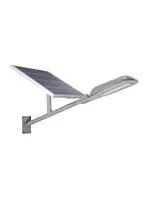
The solar panel adds a wind-exposed area to the pole. Structural calculations should therefore include the panel, bracket, luminaire, battery enclosure, and other mounted devices.
Request Test Reports and Certificates
A certificate name on a quotation is not sufficient. Buyers should check whether the report covers the exact model, wattage, component configuration, and production version being offered.
Depending on the project, useful documents may include:
Photometric test report
IES or LDT file
Electrical safety report
Ingress-protection test
Impact-protection test
LED lumen-maintenance data
Battery test report
Solar panel qualification documents
Pole material certificate
Galvanizing inspection report
Structural calculation
The IES Lighting Library includes standards covering photometric, electrical, color, life, and thermal testing used to evaluate lighting products and installations.
Solar Street Light Specification Comparison Checklist
| Specification Category | What Buyers Should Verify |
|---|
| LED | Actual power, lumens, efficacy, optics, and operating schedule |
| Solar panel | Rated power, voltage, efficiency, size, orientation, and warranty |
| Battery | Voltage, Ah, Wh, usable capacity, chemistry, and cycle conditions |
| Controller | Charging method, protection, dimming, sensing, and communication |
| Autonomy | Backup nights, brightness profile, and recovery assumptions |
| Housing | Materials, IP rating, IK rating, corrosion resistance, and heat management |
| Pole | Steel, dimensions, wind loading, galvanizing, anchors, and foundation |
| Documents | Drawings, calculations, test reports, certificates, and warranty |
FAQ
Is Higher Solar Street Light Wattage Always Better?
No. Higher wattage increases energy consumption and may require a larger panel and battery. The correct selection depends on the required light level, optics, pole height, spacing, and operating schedule.
Should Battery Capacity Be Compared in Ah or Wh?
Watt-hours provide a more useful energy comparison because they include both battery voltage and ampere-hour capacity.
What Does Three Rainy Days of Autonomy Mean?
It should mean that the battery can support the stated lighting schedule for three nights with limited charging. Buyers must confirm the brightness and hours used in the calculation.
Does IP65 Mean the Complete System Is Waterproof?
No. IP65 applies to the tested enclosure and conditions. Connectors, batteries, controllers, cable entries, and installation workmanship must also provide suitable outdoor protection.
What Is the Most Important Document for Comparing Lighting Performance?
A project-specific photometric layout supported by a valid IES or LDT file is more useful than wattage alone because it shows the expected light levels and uniformity across the target area.
Conclusion
Reading solar street light specifications requires more than checking LED wattage, battery ampere-hours, or solar panel power. Buyers must evaluate how the luminaire, panel, battery, controller, pole, foundation, and operating schedule work together.
Reliable quotations should state actual lumen output, usable battery energy, dimming profiles, rainy-day assumptions, controller settings, environmental protection, structural requirements, and supporting test reports.
By comparing suppliers using the same technical format and project conditions, buyers can identify realistic system performance and avoid exaggerated wattage, incomplete battery claims, unsuitable poles, and unreliable autonomy estimates.

 English
 français
 Español
 العربية
 Pilipino
 ไทย
ไทย tiếng việt
 Malay
Malay русский