High-power road lighting places greater demands on every part of a standalone solar system. More nighttime light generally means more electrical energy consumption, which can require greater photovoltaic generation, larger battery storage, higher controller capacity, stronger mounting structures, and a carefully optimized operating profile. At a certain project scale, fitting all of these functions into one compact housing may become less practical.
This is where split architecture can provide an engineering advantage. By separating the LED luminaire, solar panel, battery, and other major components, designers gain more freedom to size and position each element according to the actual road and energy requirements.
Split architecture is not automatically the correct choice for every powerful street light. It becomes especially useful when high lighting output is combined with long operating hours, large panel area, extended autonomy, difficult solar conditions, demanding road geometry, or project-specific maintenance requirements.
Why High-Power Road Lighting Changes Solar System Architecture
A solar street light is an energy system as well as a luminaire. Increasing road-lighting demand affects the complete energy chain.
If LED operating power increases, nighttime Wh consumption generally increases unless the difference is offset through improved luminaire efficacy, optics, reduced operating time, or intelligent dimming. The battery must store enough usable energy to supply the load, and the photovoltaic module must subsequently replace that energy.
For a split solar street light, the major components are not constrained to one compact assembly. This allows the system designer to use a larger or differently positioned photovoltaic module and a battery enclosure sized according to the actual project requirement.

That flexibility becomes increasingly valuable as projects move from small secondary roads toward wide roads, industrial corridors, logistics facilities, access roads, and other demanding applications.
High LED Wattage Should Not Be the Starting Point
A high-power road project should not begin by deciding that every pole requires an 80W, 100W, or 120W luminaire. The required electrical power should follow the photometric design.
Road width, number of lanes, pole height, pole spacing, optical distribution, luminaire efficacy, mounting arrangement, required illumination, uniformity, and other lighting criteria all affect the final result.
A luminaire with appropriate optics may use available lumens more effectively than a higher-wattage fixture with unsuitable light distribution.
The U.S. Department of Energy's guidance for purchasing energy-efficient exterior lighting emphasizes performance-based evaluation for roadway and area luminaires and also identifies the potential value of advanced lighting controls.
For solar projects, this is particularly important because every unnecessary watt of nighttime consumption can increase required battery and photovoltaic capacity.
Split Architecture Makes Larger Solar Arrays Easier to Configure
Compact integrated lights are physically limited by the amount of photovoltaic area that can reasonably be incorporated into the fixture design.
A high-power solar road system may require substantially more daily charging energy. Split architecture allows the photovoltaic module to be sized with fewer restrictions from luminaire dimensions.
Where required, projects may use larger panels or carefully engineered multiple-panel arrangements. The panel can also be oriented according to solar exposure rather than being forced to follow the exact direction of the LED luminaire.
This independence can be useful on roads whose direction is unfavorable for solar collection or where site geometry requires a specific luminaire orientation.
However, increasing photovoltaic area also affects wind loading, bracket design, pole strength, transportation, and installation. Solar oversizing should therefore be part of the complete structural design rather than treated as a simple electrical upgrade.
Larger Battery Storage Can Be Easier to Accommodate
High nighttime consumption and long autonomy requirements can create a large battery-storage requirement. In an integrated fixture, physical housing size and weight can limit how much battery capacity is practical.
A split architecture allows the battery to use a dedicated enclosure. Depending on project conditions, that enclosure may be mounted on the pole, installed at ground level, or positioned in another engineered location.
This provides greater freedom to size storage according to calculated Wh requirements instead of selecting capacity according to the remaining space inside a luminaire housing.
It can also improve serviceability because the battery may be replaced independently from the LED luminaire or photovoltaic module.
For large road projects, this modular approach can be valuable because batteries, LEDs, solar panels, and controllers do not necessarily follow identical maintenance or replacement cycles.
High-Power Systems Benefit From Component-Level Thermal Separation
LEDs, batteries, controllers, and other power electronics all have thermal operating considerations. Higher electrical loads can increase the importance of heat dissipation.
Split architecture physically separates major components, which can give engineers more freedom to manage their thermal environments individually.
The LED luminaire can use a housing designed primarily around optical performance and heat dissipation. The photovoltaic module is mounted independently in direct sunlight, while the battery can be positioned in an enclosure selected according to storage and environmental requirements.
This does not mean that split systems automatically operate at lower temperatures. A poorly positioned ground cabinet or sealed enclosure exposed to strong solar radiation can still experience severe heat.
The advantage is design freedom. Engineers have more options to determine where each component should be installed rather than requiring several functions to share one compact physical space.
Modular Architecture Can Simplify Long-Term Component Replacement
A modular solar street light architecture can be useful when project owners expect the lighting system to remain in service over many years.
The LED luminaire, battery, solar module, controller, and structural components may age differently. A battery may eventually require replacement while the pole, photovoltaic module, and luminaire remain serviceable.
In a split architecture, individual components can often be accessed without replacing the entire lighting assembly.
This can also make future technical upgrades easier. If the project owner later changes controller functionality, energy storage, or another modular component, the modification may be possible without redesigning every part of the system.
However, modularity also creates more electrical connectors, cables, brackets, and physical interfaces. Those interfaces should use suitable environmental protection and remain accessible for inspection.
High-Power Projects Make Cable Design More Important
Separating components introduces greater electrical distance between them. As system power rises, this becomes increasingly important.
For the same system voltage, higher power means higher current. Higher current increases the significance of conductor resistance and voltage drop.
This means a high-power split system should include defined cable lengths and conductor sizes rather than treating wiring as an unspecified installation accessory.
Battery voltage, photovoltaic voltage, controller location, luminaire power, cable routing, conductor cross-section, connectors, and protective devices should all be reviewed together.
Where electrical distances become substantial, designers may consider an architecture with a higher operating voltage to reduce current for a given power requirement, provided all components are designed for that voltage.
The main advantage of split architecture is therefore flexibility, but that flexibility needs disciplined electrical engineering to deliver reliable performance.
Independent Panel Orientation Helps Difficult Road Alignments
The direction that provides the best road illumination is determined by photometric requirements. The direction that provides favorable solar exposure is determined by geography and site conditions. These two directions do not always match.
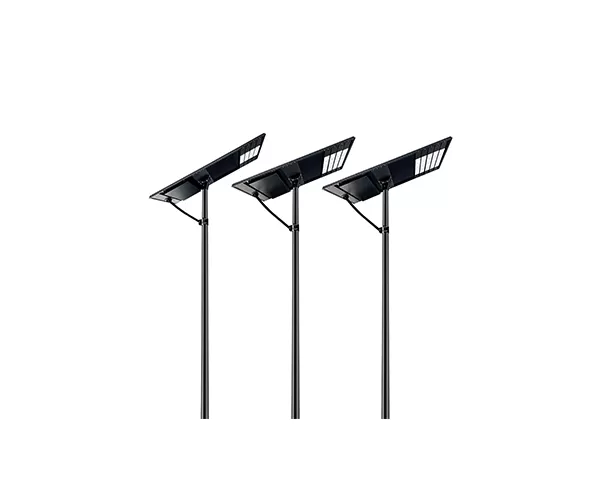
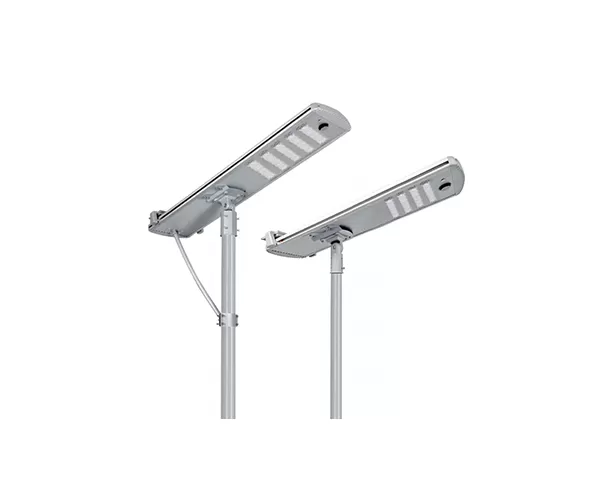
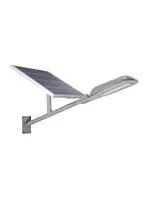
A split type solar street light allows the luminaire and photovoltaic module to be positioned independently.
This can be valuable on long highways, curved roads, industrial routes, or projects where poles must follow existing infrastructure. The luminaire remains aimed toward the required roadway area, while the photovoltaic module can use another orientation or tilt.
Panel independence may also help avoid localized shading from signs, trees, buildings, utility infrastructure, or other roadside objects.
Site analysis remains necessary. Adjustable panels cannot solve a location that receives inadequate solar radiation throughout much of the day, but they provide engineers with more options for optimizing available solar energy.
Split Systems Can Support More Demanding Autonomy Requirements
Autonomy becomes challenging when a high-power luminaire must continue operating through periods of weak solar generation.
A system designed for several nights of reserve needs enough usable battery energy to support the programmed load. It also needs sufficient photovoltaic capacity to recover that stored energy after poor-weather periods.
Split architecture can make both requirements easier to address because larger battery enclosures and photovoltaic modules can be incorporated without fitting everything into a compact lamp housing.
However, oversizing components is not a substitute for energy management.
Scheduled dimming can significantly reduce nighttime consumption during periods when full output is unnecessary. Motion sensing or adaptive controls may provide further savings for appropriate applications.
The most efficient high-power system is therefore often one that combines suitable optics, controlled LED output, realistic autonomy, adequate storage, and sufficient solar generation rather than relying on maximum component sizes.
High-Power Split Systems Need Stronger Structural Coordination
Larger photovoltaic panels and heavier equipment can place additional demands on the pole and mounting system.
DOE guidance on photovoltaic system design notes that PV mounting structures need to support arrays while withstanding environmental forces such as wind, rain, and corrosion. These considerations become especially important when photovoltaic equipment is mounted several meters above ground.
For road lighting, engineers should evaluate panel dimensions, mounting angle, bracket geometry, pole height, steel specification, wall thickness, arm configuration, foundation, and local design wind conditions as one structural system.
A larger photovoltaic module improves potential energy collection but also increases exposed surface area. In high-wind or coastal regions, this trade-off can affect the practical maximum panel size.
The final system should therefore balance energy requirements against structural and installation constraints.
When Is Split Architecture More Appropriate Than an Integrated Design?
Split architecture becomes particularly attractive when a project requires higher lighting output combined with substantial battery Wh, large photovoltaic capacity, flexible solar-panel orientation, several days of autonomy, independent component servicing, or specialized pole layouts.
It can also make sense where project owners require detailed engineering control over battery type, panel capacity, controller functions, cable routes, and maintenance procedures.
By contrast, an integrated architecture may remain more efficient for lower-power applications where solar conditions are favorable, battery requirements are moderate, and rapid installation is a major priority.
A small residential road does not necessarily benefit from the additional cables, brackets, enclosures, and installation work associated with a split system.
Architecture should therefore follow system requirements. Split design becomes valuable when component independence solves real energy, structural, installation, or maintenance constraints.
How Should EPC Buyers Specify a High-Power Split System?
Begin with road data rather than a catalog wattage. Provide project location, road width, number of lanes, required lighting performance, proposed pole height, spacing, operating hours, and environmental conditions.
The manufacturer can then propose the luminaire and photometric configuration. Once actual nighttime consumption is known, photovoltaic capacity and battery Wh can be calculated according to local solar conditions and required autonomy.
The specification should also define panel arrangement, battery location, controller program, system voltage, cable requirements, pole design, environmental protection, and maintenance access.
For comparison between suppliers, request the same technical information from each manufacturer. This helps identify whether a lower quotation results from genuine design efficiency or simply from smaller batteries, reduced photovoltaic capacity, different actual LED power, or lighter structural components.
High-Power Split Solar Street Light FAQs
Why are split solar street lights suitable for high-power road projects?
The separated architecture provides more flexibility for larger photovoltaic modules, greater battery storage, independent panel orientation, component cooling, and long-term maintenance.
Does a high-power road always require a split solar system?
No. Architecture should follow the calculated lighting and energy requirements. An integrated system may still work where the required output, storage, and solar capacity fit comfortably within its design limits.
Can split solar street lights use multiple photovoltaic panels?
Multi-panel configurations can be engineered where additional photovoltaic capacity is required, but controller limits, mounting structure, wind loading, wiring, and battery charging requirements must all be considered.
Where should the battery be installed on a high-power split system?
Possible locations include a pole-mounted enclosure, ground cabinet, or another engineered location. The choice depends on battery size, cable distance, maintenance access, flooding, security, temperature, and structural conditions.
Does a bigger battery guarantee more rainy-day autonomy?
Not by itself. Larger storage can support more nighttime energy, but the photovoltaic system must also be capable of recharging the battery. Actual autonomy depends on usable battery capacity, nightly consumption, solar input, controller settings, and system losses.
Why are photometric calculations especially important for high-power systems?
They help determine how much lighting output is actually required. Avoiding unnecessary LED power can reduce battery and photovoltaic requirements while still meeting the road's lighting target.
Conclusion
Split solar street lights make the most sense for high-power road projects when the required energy and structural configuration becomes difficult to package into a compact integrated product. Separating the luminaire, photovoltaic module, battery, and controller gives engineers greater freedom to optimize each component around real road and site conditions.
This flexibility can support larger solar arrays, higher battery capacity, independent panel orientation, modular maintenance, and demanding autonomy requirements. At the same time, it introduces additional engineering responsibilities involving cables, connectors, voltage drop, brackets, wind loading, enclosures, and component locations.
For EPC contractors and municipal buyers, the decision should not be based simply on a “high wattage” label. Split architecture delivers its greatest value when photometric demand, nighttime energy consumption, local solar resources, storage requirements, environmental conditions, and maintenance strategy are evaluated as one complete high-power road-lighting system.

 English
 français
 Español
 العربية
 Pilipino
 ไทย
ไทย tiếng việt
 Malay
Malay русский