Battery and solar-panel sizing for a 40W street light should begin with energy consumption, not with a standard battery Ah or panel wattage copied from another project. A 40W LED operating for 12 hours can theoretically consume 480Wh, but a programmed dimming schedule may reduce that figure substantially. Battery usable capacity, system losses, autonomy, local solar radiation, seasonal weather, and panel orientation then determine how much storage and photovoltaic capacity are actually required.
This article explains the engineering calculation step by step. All numerical examples are simplified project references for illustrating the method. They are not fixed specifications for every 40W system.
Calculate Nightly LED Consumption First
For a 40W solar street light, a basic full-power calculation is straightforward.
For 10 hours:
40W × 10h = 400Wh
For 12 hours:
40W × 12h = 480Wh
These are theoretical LED load figures before controller consumption and system losses are considered.
They provide a useful starting point because battery capacity and solar generation can then be evaluated against daily energy demand rather than against the nominal 40W label.
Use the Actual Dimming Schedule Instead of Rated Wattage
Solar street lights frequently use staged nighttime control.
Consider an illustrative 12-hour profile:
4 hours at 40W = 160Wh
4 hours at 24W = 96Wh
4 hours at 12W = 48Wh
Total theoretical LED consumption becomes:
160 + 96 + 48 = 304Wh/night.
This is approximately 37% lower than the 480Wh consumed by continuous 40W operation for 12 hours.
The example demonstrates why two suppliers can quote the same nominal 40W luminaire but propose different battery capacities. Their control profiles may be different.
EPC buyers should request the exact dimming schedule used in every sizing calculation.
Add System Consumption and Conversion Losses
The LED is not the only device consuming energy. Controllers, drivers, sensors, communication equipment, and other electronics can add load. Energy also passes through components with less than 100% efficiency.
For a simplified calculation, an engineer may apply an overall design factor to the LED Wh requirement.
For example, if the theoretical LED load is 304Wh and an illustrative 15% allowance is used for system consumption and losses:
304Wh × 1.15 = approximately 350Wh/day.
The 15% value is only a calculation example. Final losses should reflect the actual controller, driver, battery, wiring, and system architecture.
Using a documented efficiency assumption is better than ignoring losses entirely.
Convert Battery Ah Into Wh Before Comparing Products
Battery capacity is frequently advertised in amp-hours, but Ah cannot be compared accurately without voltage.
The basic relationship is:
Battery Wh = nominal voltage × Ah.
For example:
12.8V × 42Ah = 537.6Wh.
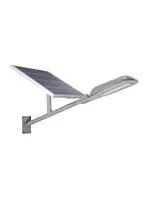
Inbrit's current representative SOLO-A 40W configuration lists a 12.8V / 42Ah LiFePO4 battery, corresponding to 537.6Wh nominal energy, together with a 120W solar panel. This is a specific reference configuration rather than a universal specification for every 40W project.
Another project may require more or less storage depending on operating schedule, autonomy, solar resource, and architecture.
Nominal Battery Wh Is Not Fully Usable Wh
A 537.6Wh nominal battery should not automatically be assumed to provide 537.6Wh of planned nightly energy.
Battery management systems and controllers normally maintain operating limits. Usable capacity can also be influenced by battery chemistry, discharge rate, temperature, aging, and warranty strategy.
Consider an illustrative case where the design treats 80% of nominal battery capacity as usable:
537.6Wh × 80% = approximately 430Wh usable.
The 80% figure is not a universal LiFePO4 design requirement. The actual usable percentage should follow the battery manufacturer's technical data and the controller configuration.
Buyers should request both nominal Wh and the usable-capacity assumption behind the supplier's autonomy calculation.
Autonomy Determines How Much Stored Energy Is Needed
If a system requires approximately 350Wh per night after the selected design assumptions, then one night requires approximately 350Wh of usable energy.
Two theoretical no-charge nights would require:
350Wh × 2 = 700Wh usable energy.
Three would require:
350Wh × 3 = 1,050Wh usable energy.
Actual rainy-day sizing is more complex because cloudy weather may still produce some photovoltaic energy, and the controller may use an energy-saving schedule as battery SOC declines.
Nevertheless, this calculation is useful for auditing exaggerated autonomy claims. If the claimed several-night autonomy cannot be reconciled with battery Wh and expected load, buyers should request the detailed assumptions.
Calculate the Daily Energy the Solar Panel Must Replace
The solar panel must replace the energy removed from the battery while also accounting for charging and system losses.
Suppose the system needs approximately 350Wh of charging energy per day under the selected operating assumptions.
If the site receives an illustrative 5 equivalent peak-sun hours:
350Wh ÷ 5h = 70W theoretical PV power.
At 4 hours:
350Wh ÷ 4h = 87.5W.
At 3 hours:
350Wh ÷ 3h = approximately 117W.
These values are theoretical before additional allowance for photovoltaic temperature, dirt, orientation, controller efficiency, battery charging, aging, seasonal variation, and cloudy-day recovery.
This is why panel sizing should never be based only on LED wattage.
Use Off-Grid Solar Data for the Project Location
A useful external reference for this type of energy analysis is the European Commission Joint Research Centre's PVGIS Off-grid PV tool.
Its off-grid calculation uses inputs including location, PV nominal power in watts, battery capacity in Wh, discharge cutoff, and daily electricity consumption in Wh. It then simulates energy flows using the available solar-radiation database.
This reflects the same core engineering relationship required for solar street lighting: daily load, battery storage, photovoltaic capacity, and local solar resources need to be analyzed together.
For project design, monthly and weak-season performance should receive particular attention rather than relying only on annual average sunlight.
Do Not Size the Panel From the Best Solar Month
A system that performs comfortably during summer may experience an energy deficit during the weakest solar season.
If the project requires year-round lighting, the designer should examine solar availability during the months most likely to challenge battery recovery.
For example, a theoretical 80W panel may appear sufficient when calculated with five peak-sun hours but become inadequate if the relevant low-season condition is closer to three hours.
This does not mean every system must be designed for the most extreme possible weather event. The project owner must define the required reliability and acceptable autonomy.
The important point is that the design basis should be transparent.
Solar Panel W and Battery Wh Must Be Balanced
A large battery combined with a small photovoltaic module is not necessarily a reliable design.
The battery may provide several nights of reserve, but after deep discharge the panel must restore that energy. If daily charging capacity is only slightly greater than normal daily consumption, full recovery can take many days.
Conversely, a very large panel paired with insufficient storage may produce surplus daytime energy that cannot be retained for nighttime operation.
The panel and battery should therefore be selected as one energy system.
A balanced configuration supports the normal nightly load, maintains the required reserve, and provides reasonable recovery after weak-solar periods.
Check the Controller Before Increasing Panel Wattage
Increasing panel wattage is only useful when the controller can accept the selected PV module.
Engineers should verify maximum photovoltaic input voltage, maximum charging current, battery voltage, power limits, and panel electrical characteristics.
The controller should also be configured for the selected battery chemistry.
If the standard 40W product configuration uses one controller and the project requires a significantly larger photovoltaic array because of weak solar conditions, controller capacity may need to change as well.
This is another reason panel wattage should not be modified independently.
Panel Orientation and Shading Can Change the Calculation
Theoretical photovoltaic wattage assumes the module can actually receive the expected solar radiation.
Buildings, trees, utility equipment, mountains, signs, and other objects can create shading. Incorrect orientation or tilt can further reduce daily charging energy.
A site survey should therefore check the solar-panel position before battery oversizing is used to compensate for poor charging conditions.
Where shading cannot be avoided at the luminaire position, a split or separate-panel architecture may allow the photovoltaic module to be located more favorably.
Temperature Should Be Included in the Battery Review
Battery performance changes with operating temperature. Charging limitations can become particularly important in very cold conditions, while high temperatures can affect long-term battery aging.
Solar-panel output also changes with module temperature.
For projects in extreme climates, the calculation should therefore include the temperature range specified for the actual battery and controller rather than assuming ideal laboratory conditions throughout the year.
The battery enclosure location and thermal design may also influence usable performance.
A Practical 40W Calculation Workflow
First, define the LED operating schedule and calculate nightly Wh.
Second, add realistic controller, driver, sensor, wiring, and conversion losses.
Third, determine the required usable battery energy according to autonomy and battery operating limits.
Fourth, convert the selected battery's voltage and Ah rating into nominal Wh and verify the usable-capacity assumption.
Fifth, use location-specific solar data to estimate how much photovoltaic capacity is required during relevant seasonal conditions.
Finally, verify panel orientation, shading, controller limits, temperature, battery recovery, physical panel dimensions, and pole structural requirements.
This process produces an auditable energy design instead of simply matching a 40W lamp with a battery and panel from a generic table.
40W Solar Street Light Battery and Panel FAQs
How many Wh does a 40W street light use in 10 hours?
At constant 40W LED power, the theoretical load is 400Wh. Actual system energy demand can be higher after controller and conversion losses are considered.
How much energy is required for 12 hours?
Continuous 40W operation for 12 hours equals 480Wh of theoretical LED energy. A dimming program can reduce this substantially.
How do I convert a battery from Ah to Wh?
Multiply nominal battery voltage by amp-hours. For example, 12.8V × 42Ah equals 537.6Wh nominal energy.
What size solar panel does a 40W street light need?
There is no universal panel wattage. Daily load, peak-sun hours, losses, seasonal solar radiation, recovery requirements, shading, orientation, and controller limits all affect sizing.
Is a 120W solar panel always required for a 40W lamp?
No. A 120W panel appears in one current Inbrit 40W reference configuration, but other projects can require different photovoltaic capacity according to site and operating requirements.
Why should battery capacity be compared in Wh instead of Ah?
Wh includes both battery voltage and Ah capacity, making it possible to compare the stored energy of systems using different nominal voltages.
Conclusion
Battery and solar-panel sizing for a 40W street light begins with a simple principle: calculate energy in watt-hours before selecting components. Continuous 40W operation requires approximately 400Wh over 10 hours or 480Wh over 12 hours before additional losses, while staged dimming can reduce the nightly requirement significantly.
The battery must provide sufficient usable Wh for the approved load and autonomy target. The photovoltaic module must then replace that energy under the project's real solar conditions while maintaining enough capacity for recovery after weak-weather periods.
For EPC and municipal buyers, the strongest proposal is not one that simply lists “40W LED, 120W panel, 42Ah battery.” It is one that shows the full calculation: nighttime Wh, usable battery energy, local solar input, panel sizing, controller limits, and recovery assumptions. That transparent energy balance makes different supplier configurations much easier to compare and verify.




 English
 français
 Español
 العربية
 Pilipino
 ไทย
ไทย tiếng việt
 Malay
Malay русский