High mast lighting can place multiple luminaires 20, 30, or even 40 meters above ground, which creates an obvious maintenance question: how will technicians inspect or replace luminaires, drivers, surge protection devices, cables, and other equipment safely after installation?
The answer depends heavily on the headframe and maintenance architecture. Some high mast systems use a lowering ring operated by a manual winch. Others use an electric drive to raise and lower the luminaire carriage. Fixed-head systems keep the luminaires permanently at the top of the mast and require another access method for maintenance.
For EPC contractors, ports, airports, stadiums, parking facilities, and highway projects, choosing between these arrangements should not be based only on initial equipment price. Maintenance frequency, mast height, luminaire quantity, technician access, available power, safety procedures, downtime, and lifecycle service costs all matter.
Why the Maintenance System Should Be Specified Before the Pole
The maintenance method affects the internal and external architecture of the entire mast. A lowering system may require a winch, steel wire ropes or cables, pulleys, guide mechanisms, headframe locking devices, internal electrical connections, a handhole, and an operating mechanism near the base.
A high mast light pole should therefore be specified together with its intended headframe and maintenance strategy rather than treating the lowering mechanism as an accessory that can be added later.
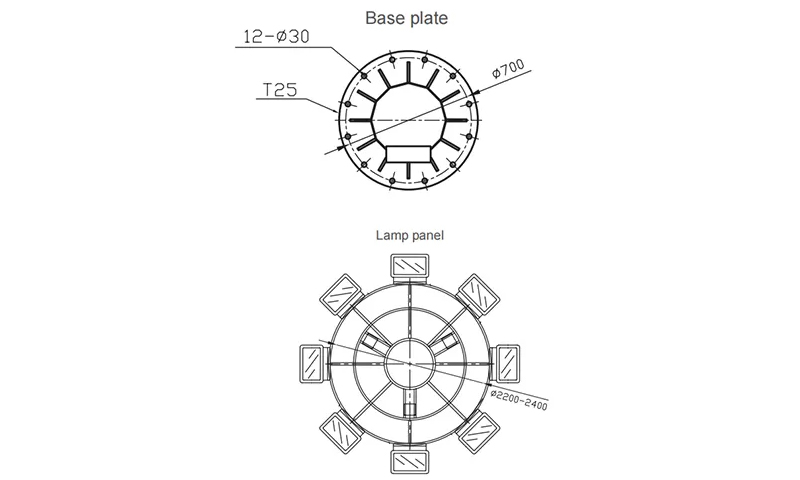
FHWA guidance on high mast lighting specifically notes that tower and high mast designs must address access to luminaires for maintenance and refers to internal luminaire lowering mechanisms as one approach.
For project buyers, the practical question is simple: when a luminaire fails several years after commissioning, how will the maintenance team reach it, what equipment will be required, and how long will the work disrupt the site?
How a Lowering High Mast System Works
A lowering system typically places the luminaires on a movable carriage or headframe. Steel wire ropes or another engineered suspension arrangement support the carriage during raising and lowering.
At the top of the mast, pulleys guide the lifting cables. At the bottom, a winch or drive mechanism controls movement. Depending on the design, the carriage may lock mechanically into its operating position at the top so the suspension cables do not continuously carry the full operational load in the same manner during service.
The exact mechanical design varies by manufacturer. Procurement documents should therefore identify the actual system architecture rather than relying on the generic phrase “with lowering device.”
Buyers should understand the winch arrangement, cable system, headframe locking mechanism, electrical connection method, operating procedure, and safety provisions before approval.
Manual Winch Systems Reduce Dependence on Powered Drive Equipment
A manual lowering system uses mechanical input from the operator to drive the winch. Depending on the system, this may involve a removable handle or another approved operating tool.
The main advantage is reduced dependence on an electric drive motor. This can be useful at remote locations where maintenance power is not readily available or where project owners want a mechanically simple operating arrangement.
Manual systems may also reduce the number of powered components that need periodic electrical inspection.
However, the effort required to lower and raise the carriage depends on the headload, winch ratio, mechanical design, and luminaire quantity. A system suitable for a moderate headload may become inconvenient if the carriage supports many heavy LED fixtures.
EPC buyers should therefore avoid specifying “manual winch” without confirming the permitted headload and operating procedure.
Electric Lowering Systems Can Simplify Heavy Headframe Operation
An electric lowering system uses a powered drive to operate the winch or lifting mechanism. This can make raising and lowering a heavy luminaire carriage more convenient, particularly on taller high masts carrying several fixtures.
For large ports, interchanges, stadium surroundings, industrial yards, and parking areas, this can reduce the physical effort required during routine maintenance.
However, powered operation introduces additional requirements. The project needs a suitable electrical source, control arrangement, motor protection, operating controls, emergency procedure, and appropriate maintenance for the drive system itself.
Buyers should confirm whether the electric drive is permanently installed or connected only when maintenance is required. They should also determine how the system can be operated if the normal power supply is unavailable.
An electric system should therefore be evaluated as a maintenance tool with its own technical requirements rather than simply as a convenience feature.
Manual and Electric Drives Can Share the Same Basic Lowering Architecture
The distinction between manual and electric systems can sometimes be misunderstood. In many designs, both approaches perform the same fundamental task: driving a winch that raises or lowers the luminaire carriage.
The main difference is how mechanical power is supplied to the lifting mechanism.
This means project buyers should not compare only “manual versus electric.” They should also compare cable quantity and construction, winch capacity, pulley arrangement, headframe guides, locking system, safety factor, operating speed, maintenance access, and replacement-part availability.
A reliable manual system can be preferable to a poorly engineered electric system, and vice versa. Overall mechanical design is more important than the power source alone.
Fixed Headframes Use a Completely Different Maintenance Strategy
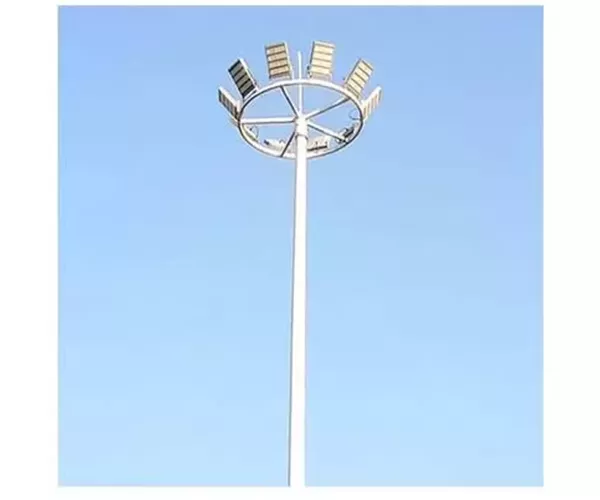
A fixed headframe remains permanently at the top of the mast. The luminaires are not lowered to ground level through an internal winch-and-cable system.
This can simplify the mast by removing several moving components associated with lowering equipment. There may be no lifting winch, movable carriage, lifting cables, or headframe latching system to inspect.
The trade-off is maintenance access.
If a driver, luminaire, SPD, connector, or cable termination requires service, technicians need a suitable method to reach the top of the mast. Depending on mast height and site conditions, this may involve specialized elevated-access equipment or another approved access arrangement.
For very tall installations, this can significantly affect maintenance planning and cost.
When Can a Fixed Headframe Still Make Sense?
A fixed head arrangement may be appropriate where reliable elevated-access equipment is readily available, maintenance frequency is expected to be low, or project operators prefer to minimize moving mechanical components within the mast.
It may also be considered where the mast configuration, luminaire quantity, site access, or local maintenance practices make a lowering system less valuable.
However, the project should calculate lifecycle implications rather than focusing only on lower initial mechanical complexity.
A port or airport may already own suitable high-access equipment. A remote highway project may not. The same fixed-head mast can therefore create very different maintenance costs at different sites.
The Headload Must Match the Lowering System Capacity
The movable headframe does not carry only the LED fixtures. The total headload can include luminaires, brackets, mounting ring, junction boxes, cables, surge protection devices, control equipment, and other accessories.
If the lighting design changes from six luminaires to eight, or if heavier fixtures are substituted during procurement, the effect on the lowering system should be checked.
Winch capacity, cable loading, headframe structure, pulley system, and locking arrangement must all remain suitable for the final configuration.
This is why equipment substitutions should be reviewed structurally and mechanically instead of assuming that a luminaire with similar wattage is automatically interchangeable.
Locking and Latching at the Top Need Clear Verification
For systems using a movable carriage, reaching the top position is only part of the operating sequence. The carriage must also locate and secure correctly in its intended operating position.
The project team should understand how the headframe confirms correct engagement and what prevents unintended movement after lifting.
The manufacturer should provide operating instructions showing the normal raising, locking, unlocking, and lowering sequence.
During commissioning, the mechanism should be tested through its full operating cycle before the mast enters normal service.
Technicians should not have to determine whether the headframe is correctly engaged by guesswork from ground level.
Wire Ropes, Pulleys and Winches Need Periodic Inspection
A lowering system reduces the need to work at height, but it introduces mechanical components that require inspection.
Maintenance procedures may include checking lifting cables or wire ropes for wear, corrosion, broken strands, deformation, or abnormal tension. Pulleys should rotate correctly, while winch components, guides, fasteners, and locking mechanisms should be inspected according to the manufacturer's requirements.
The maintenance interval should follow the approved system documentation, local regulations, environmental exposure, and actual operating frequency.
Coastal, industrial, or highly corrosive environments may justify particular attention to mechanical components and protective finishes.
Electrical Connections Must Accommodate Carriage Movement
A lowering headframe requires an electrical architecture that allows the luminaire assembly to move between its operating position and maintenance position.
The system may use internal cables, connectors, junction arrangements, or another engineered electrical interface.
These components should be designed so that repeated raising and lowering does not create uncontrolled twisting, abrasion, excessive tension, or damage to electrical conductors.
Before procurement, buyers should request a wiring diagram showing how power reaches the moving headframe and how electrical isolation is performed before maintenance.
Maintenance Area at Ground Level Should Not Be Overlooked
A lowering system is most useful when the carriage can be serviced safely after it reaches ground level.
The mast location should therefore provide enough clear space for the lowered headframe, technicians, tools, replacement luminaires, and maintenance vehicles.
A mast located inside a narrow traffic island, beside a barrier, or within an active container route may technically have a lowering mechanism but still be difficult to service.
Maintenance access should consequently be reviewed during civil layout design rather than after the mast foundations are constructed.
What Should EPC Buyers Include in the Lowering-System Specification?
The RFQ should define mast height, number and weight of luminaires, complete headload, headframe type, manual or electric drive preference, lowering mechanism, cable or wire-rope system, locking method, operating controls, maintenance access, and applicable safety requirements.
Buyers should also request an operating and maintenance manual, exploded mechanical drawings where appropriate, spare-part information, and commissioning procedures.
If a fixed headframe is proposed, the supplier and project owner should identify the intended maintenance-access method and verify that it is realistic for the site.
High Mast Lowering System FAQs
What is the main advantage of a high mast lowering system?
It allows the luminaire carriage to be brought toward ground level for inspection and maintenance, reducing the need to access the luminaires at full mast height.
Is an electric lowering system better than a manual winch?
Not automatically. Electric drives can simplify operation for heavier headloads, while manual systems reduce dependence on powered drive equipment. The choice should reflect mast height, headload, maintenance resources, and lifecycle requirements.
What is a fixed high mast headframe?
It is a luminaire-support structure that remains at the top of the mast rather than being lowered through an internal lifting system. Maintenance therefore requires another approved access method.
Do lowering-system cables need inspection?
Yes. Lifting cables, winches, pulleys, guides, fasteners, and locking mechanisms are mechanical components and should be inspected according to the manufacturer's maintenance requirements.
Can more LED fixtures be added to the headframe later?
Only after confirming that the headframe, mast, lowering mechanism, cables, winch, structural design, electrical system, and foundation remain suitable for the increased load.
Should the lowering system be tested before commissioning?
Yes. The complete raising, locking, unlocking, lowering, and electrical operation should be checked according to the manufacturer's procedure before normal service.
Conclusion
Manual, electric, and fixed headframe high mast systems represent different maintenance strategies rather than simple equipment grades. Manual winches can provide mechanically straightforward operation, electric drives can make heavier carriages easier to handle, and fixed headframes remove some moving components but require a practical method for working at height.
For EPC and infrastructure projects, the best system depends on mast height, headload, luminaire quantity, site access, available power, maintenance equipment, environmental exposure, and the owner's long-term service strategy.
The maintenance architecture should therefore be chosen before the high mast design is finalized. When the headframe, lifting mechanism, electrical connections, ground-level access, inspection procedures, and spare parts are coordinated from the beginning, the lighting system becomes easier and safer to maintain throughout its operating life.

 English
 français
 Español
 العربية
 Pilipino
 ไทย
ไทย tiếng việt
 Malay
Malay русский