A 20W LED street light operating for 10 or 12 hours does not simply require a “20W solar panel” and a battery with an arbitrary amp-hour rating. The solar module has only daylight hours to replace the energy consumed throughout the night, while the battery must store enough usable energy to support the lighting schedule and the project's required reserve.
Correct sizing therefore begins with watt-hours, not component labels. Engineers need to calculate the actual nighttime load, account for dimming, determine required battery autonomy, review usable depth of discharge, estimate system losses, and then use location-specific solar resources to select photovoltaic capacity.
The calculations below are simplified examples for understanding the engineering logic. Final panel and battery sizing should be completed for the actual project location, battery chemistry, controller, system voltage, weather conditions, and autonomy requirement.
Start With Nightly Energy Consumption in Watt-Hours
A 20W solar street light running continuously at rated LED power for 10 hours has a theoretical LED load of:
20W × 10 hours = 200Wh per night.
For 12 hours:
20W × 12 hours = 240Wh per night.
These figures are only the starting load. Actual system sizing may need to account for controller consumption, driver losses, battery conversion losses, temperature effects, and other parasitic loads.
This is why a system advertised as “20W for 12 hours” should not automatically be assumed to require only 240Wh of nominal battery storage.
Dimming Can Reduce the Nightly Energy Requirement
Many solar lighting projects do not operate at full LED output from dusk until dawn.
Suppose a 20W luminaire operates at full power for five hours and then at approximately 50% power for seven hours. Ignoring other system losses for this simplified illustration, the LED energy would be:
20W × 5 hours = 100Wh
10W × 7 hours = 70Wh
Total = 170Wh per night.
Compared with 240Wh for 12 hours at full 20W output, the staged schedule reduces theoretical LED energy consumption by about 29%.
This difference can materially change battery and solar-panel sizing. Buyers should therefore request the actual controller program used in the supplier's energy calculation.
Do Not Compare Batteries by Ah Without Checking Voltage
Amp-hours alone do not describe stored energy.
A 12.8V 20Ah battery stores approximately:
12.8V × 20Ah = 256Wh nominal energy.
A 25.6V 10Ah battery also stores approximately 256Wh.
The Ah figures are different, but nominal energy is similar.
For supplier comparisons, convert battery specifications to watt-hours whenever possible. This makes it easier to compare systems using different nominal voltages.
Battery Wh should still not be treated as fully usable energy because the system normally maintains operating limits to protect the cells and provide reliable control.
Nominal Battery Wh Is Not the Same as Usable Wh
A battery should not automatically be assumed to deliver every watt-hour shown by multiplying voltage and Ah.
Usable capacity depends on battery chemistry, BMS limits, controller settings, discharge rate, temperature, aging assumptions, and the design reserve required by the project.
For example, if an illustrative 320Wh nominal battery configuration is engineered so that only 80% is treated as normally usable, the planning value would be approximately 256Wh before considering other operating factors.
This is an example rather than a universal design rule. The correct usable percentage should follow the actual battery specification and manufacturer's requirements.
EPC buyers should therefore ask for nominal Wh, usable Wh assumptions, discharge limits, and battery protection settings rather than accepting only an Ah label.
Autonomy Changes Battery Sizing Significantly
A battery sized for one normal night is different from a battery designed to support multiple nights of weak solar generation.
If the theoretical nightly LED load is 200Wh, two nights represent 400Wh of lighting energy before losses and battery operating limits. Three nights represent 600Wh.
This does not mean the battery should simply equal nightly Wh multiplied by rainy days. Final sizing must also consider available solar charging during cloudy conditions, usable battery capacity, temperature, dimming strategy, and acceptable reserve.
Still, the example shows why buyers should always specify autonomy requirements.
A quotation promising “three rainy days” with a battery only slightly larger than one night's full-load consumption deserves closer examination of the operating schedule and assumptions.
Solar Panel Sizing Starts With the Energy That Must Be Replaced
The photovoltaic module's job is to replace the energy used during nighttime operation and recover the battery after discharge.
If the complete system needs approximately 220Wh of charging energy per typical day after allowing for the applicable design assumptions, that energy must be generated during available solar hours.
A simplified first calculation divides the required daily Wh by effective peak-sun hours.
For example:
220Wh ÷ 5 peak-sun hours = 44W.
At only 3 peak-sun hours:
220Wh ÷ 3 = approximately 73W.
These figures are theoretical before applying system derating, seasonal margins, temperature effects, controller efficiency, module orientation, contamination, aging, and recovery requirements.
They illustrate why the same 20W lamp can need substantially different solar-panel capacities in different locations.
Use Location-Specific Solar Resource Data
Solar resource should not be guessed from country reputation or annual sunshine descriptions.
The current PVWatts Calculator uses location-based solar resource and weather information to estimate photovoltaic energy production. Its published methodology notes that output variability information is based on long-term historical weather data.
PVWatts is designed primarily for grid-connected PV systems rather than standalone street-light sizing, so it should not be used as a complete off-grid battery-design tool. However, it illustrates the essential engineering principle: photovoltaic production depends strongly on location and weather.
For standalone lighting, the designer should evaluate the project's relevant monthly or seasonal solar resource, particularly the weaker solar periods that could challenge nighttime reliability.
Annual Average Sun Hours Can Hide the Worst Month
A project may have an attractive annual average solar resource but a much weaker rainy or winter season.
If the system is sized only from the annual average, the battery may experience repeated energy deficits during those low-solar months.
For year-round road lighting, designers should therefore examine monthly or seasonal resource data rather than relying only on one annual number.
A project that receives five or six effective solar hours during its best season may experience far less during the weakest period.
Panel capacity should reflect the project's required reliability during that difficult season, not only ideal-day charging performance.
Panel Orientation and Shading Affect Real Charging Energy
A correctly sized photovoltaic module cannot provide its expected energy if it is badly shaded or installed at an unsuitable orientation.
Trees, buildings, utility poles, signs, mountains, walls, and future vegetation growth can reduce available solar radiation.
Even partial shading during important charging hours can affect the energy balance.
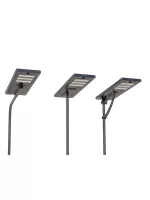
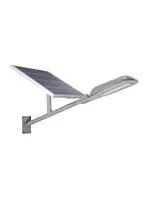
Site surveys should therefore identify expected shading before product architecture is finalized. Where panel position needs greater flexibility, an architecture with a separately mounted solar module may provide additional orientation options.
The battery should not be oversized simply to compensate for a fundamentally poor solar-panel location without first addressing the shading problem.
The Controller Must Accept the Selected Solar Panel
Increasing solar-panel wattage is only useful if the controller can safely use the additional photovoltaic input.
The designer should check maximum PV input voltage, charging current, battery voltage, controller capacity, and panel electrical characteristics.
A larger panel may exceed controller limits even when its physical size fits the pole.
This becomes particularly relevant when a low-sun project increases photovoltaic capacity beyond the configuration normally paired with a 20W lamp.
Buyers should therefore request a complete electrical match between panel, controller, battery, and LED load rather than approving each component independently.
Recovery After Cloudy Days Is Different From Overnight Autonomy
Autonomy describes how long stored energy can support the lighting load. Recovery describes how quickly the solar system can restore that energy afterward.
A very large battery paired with an undersized photovoltaic module may survive several cloudy nights but then require many good solar days to recharge fully.
During that recovery period, another cloudy day can push the system back into an energy deficit.
A balanced design therefore considers both battery reserve and photovoltaic recovery capability.
This is one reason simply adding more battery capacity does not always improve system reliability proportionally.
Temperature Can Affect Battery and Solar Performance
Outdoor energy systems experience different temperatures throughout the year.
Battery charging and discharge capability can change with temperature, and the permitted operating range depends on battery chemistry and BMS design. Photovoltaic output also changes with cell temperature and solar conditions.
Projects in very hot or cold climates should therefore include expected temperature conditions in the RFQ.
Buyers should request battery charge and discharge temperature limits, enclosure strategy, controller protections, and any project-specific derating assumptions.
A calculation based only on 25°C laboratory conditions may not represent the most demanding field period.
A Practical Sizing Workflow for a 20W Project
Start by defining actual LED operating hours and dimming stages. Convert the resulting load into nightly Wh. Add the appropriate system-consumption and efficiency assumptions.
Next, determine the required autonomy and calculate the usable battery energy needed to support that target. Select a battery whose nominal capacity can provide the required usable Wh within its approved operating limits.
Then evaluate location-specific solar data, especially weak-season conditions, and size the photovoltaic module to restore daily consumption with appropriate design margins and recovery capability.
Finally, verify controller limits, panel orientation, shading, battery temperature, physical module size, and pole or bracket requirements.
This workflow produces a much stronger system specification than choosing panel watts and battery Ah from a generic product table.
20W Solar Street Light Battery and Panel Sizing FAQs
How much energy does a 20W solar street light use in 10 hours?
At constant 20W LED power, the theoretical LED load is 200Wh. Controller losses, electronics, and other system factors can increase the required stored and generated energy.
How much energy does it use for 12 hours?
At constant rated power, 20W × 12 hours equals 240Wh of theoretical LED consumption before other system losses.
What battery size is needed for a 20W light?
There is no single universal size. Battery capacity depends on operating hours, dimming schedule, system voltage, battery chemistry, usable depth of discharge, autonomy, temperature, and system losses.
What size solar panel is required for a 20W street light?
Panel size depends on daily Wh consumption and local solar resource. A low-sun location may need significantly more photovoltaic capacity than a high-solar-resource project using the same LED load.
Is a 20Ah battery enough?
The voltage must also be known. Ah alone cannot describe battery energy. Convert voltage and Ah to Wh and then evaluate usable capacity against the required nighttime load.
Should the panel be sized from annual average sunlight?
For year-round projects, monthly or seasonal low-solar periods should also be reviewed because an annual average can hide the conditions most likely to create an energy deficit.
Conclusion
Battery and solar-panel sizing for a 20W solar street light begins with energy, not component labels. A lamp operating for 10 hours at full 20W uses approximately 200Wh of theoretical LED energy, while 12 hours requires approximately 240Wh. Dimming can reduce that load substantially, but the actual programmed schedule needs to be included in the calculation.
Battery sizing must then account for usable capacity, autonomy, temperature, protection limits, and system losses. Photovoltaic sizing should reflect location-specific solar resources, weak-season conditions, shading, system derating, controller limits, and the need to recover after cloudy periods.
For project buyers, the strongest specification is therefore not “20W lamp + 40W panel + 20Ah battery.” It is a transparent energy balance showing how much the light consumes, how much usable energy the battery stores, and how the selected solar module will replace that energy under the actual conditions of the installation site.


 English
 français
 Español
 العربية
 Pilipino
 ไทย
ไทย tiếng việt
 Malay
Malay русский