The marketplace for all-in-one solar street light products has exploded—but so has a costly problem: fake specs. If you’ve seen “1000W” integrated lights promoted at unbelievably low prices, you’ve already spotted the pattern. Many of these units look impressive out of the box, then dim sharply or fail after one or two nights because the physics simply doesn’t add up.
For project managers, municipal contractors, solar distributors, and commercial facility owners, spec inflation isn’t a minor inconvenience—it can derail budgets, trigger complaints, and create safety risks on roads, pathways, and industrial sites.
This guide gives you a practical, technical checklist to spot inflated claims in the all-in-one integrated solar street light market—so you can protect your investment and select suppliers who deliver measurable performance.
Why trust this checklist? Inbrit has been manufacturing solar lighting for 15+ years, with a documented commitment to transparent testing, batch-level reports, and engineering-backed data.
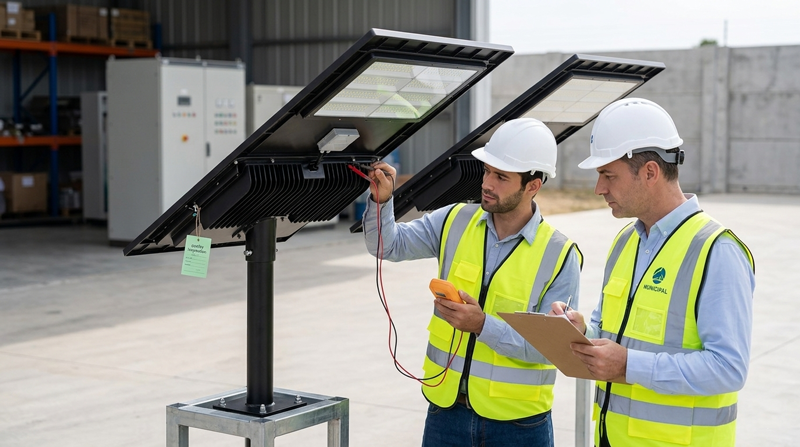
The “Wattage Trap”: Science vs. Marketing
How the scam works (Model numbers disguised as wattage)
One of the most common scams in the solar street light industry is labeling a product “1000W” when it’s not actually consuming (or producing equivalent lighting to) 1000 watts. Often, “1000W” is just a model name, not a real electrical rating—yet it’s displayed like a true power spec to influence purchasing decisions.
Reality check: a true “1000W” solar street light doesn’t fit on a pole
If a light truly required 1000W input power for long nightly operation, it would need:
A very large solar panel (think table-sized surface area, not a compact integrated panel)
A correspondingly large battery bank to supply power through the night
If the fixture has a modest panel and compact housing, the “1000W” claim is almost certainly marketing fiction.
Focus on lumens, not hype: understanding “solar street light wattage reality”
For buyers, the more meaningful metric is light output (lumens) and efficiency (lm/W). Two products labeled “200W” can perform wildly differently depending on:
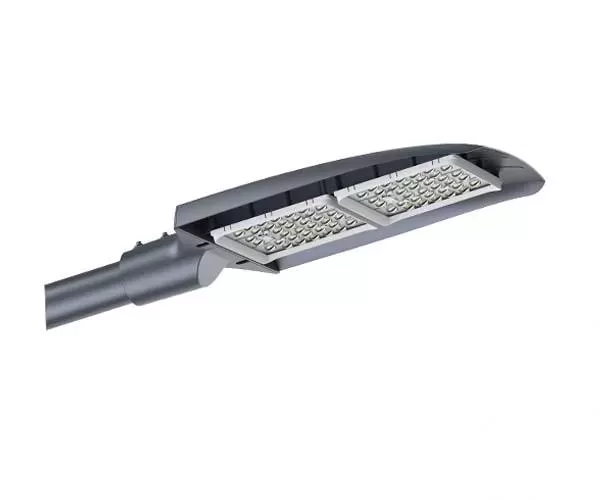
Pro tip (what real suppliers emphasize): High-quality fixtures focus on luminous efficacy rather than inflated wattage labels. A properly engineered 60w led street light can outperform a product carrying a much higher but unverifiable wattage claim. Inbrit’s Lyra series, for example, targets 160–180 lm/W efficiency—an engineering-driven metric that correlates with real-world brightness and runtime.
Battery Capacity: Beyond the Label
Battery deception is where fake-spec lights fail fastest. In a lithium battery solar street light, buyers may see decent brightness for an hour or two, followed by a steep drop because the actual usable battery capacity is far lower than claimed.
Common battery scams in integrated solar lights
Recycled/second-hand lithium cells marketed as “new”
“Capacity” printed without stating cell grade, configuration, or usable depth-of-discharge
Misleading labeling like quoting a “12V” capacity on a 3.2V system (or mixing units to make the number look larger)
How to check solar light battery capacity (a buyer’s field checklist)
1) The weight test (quick sanity check)
For LiFePO4 systems, real capacity has a practical weight range. If a supplier claims very high capacity but the fixture feels unusually light, treat it as a red flag. Weight alone doesn’t prove quality—but it can expose impossible claims.
2) Voltage verification (simple multimeter test)
Use a multimeter to confirm the battery system voltage:
A single LiFePO4 cell is typically 3.2V nominal
A 4-cell LiFePO4 pack is typically 12.8V nominal
If the label claims a 12V-class battery but the measured system indicates a different configuration, ask for the battery pack wiring diagram and test report.
3) Discharge testing (the truth serum)
Ask the supplier for a discharge curve or battery test report. You can also estimate runtime with basic math:
If the numbers don’t reconcile with the promised “3–5 rainy nights,” it's likely inflated.
Solar Panel Efficiency: Don't Get Shadowed
The solar panel is the engine of an all-in-one light. If it can’t harvest enough energy, everything else becomes marketing.
Mono vs. poly: why monocrystalline wins for highways
For high quality solar street lights for highways and demanding municipal projects, monocrystalline panels are widely preferred because they generally deliver higher efficiency and better performance in limited space—critical for compact integrated fixtures.
Size matters: panel area must match the claim
There’s an unavoidable relationship between:
Panel wattage rating
Panel surface area
Average sun hours (site-dependent)
System losses (controller, battery charge efficiency, temperature)
Red flag rule: If the panel looks small but the product claims extremely high “wattage” and long runtime at full brightness, the system energy budget likely doesn’t work.
Glass quality: tempered glass vs. yellowing laminates
Cheap PET-laminated panels may yellow, haze, or degrade faster in heat and UV exposure. For long-life projects, verify the panel build and ask for aging or material documentation when available.
Material Integrity: Die-Cast Aluminum vs. Plastic
Heat dissipation: the hidden reason LEDs “die early”
LED longevity depends heavily on thermal management. Plastic housings and poor heat paths trap heat, accelerating lumen depreciation and chip failure—sometimes within months in high-temperature environments.
What to look for: robust thermal design and die-cast aluminum construction that pulls heat away from LEDs and drivers.
Weatherproofing for real-world projects (IP ratings and corrosion resistance)
Municipal and coastal deployments demand more than “outdoor-ready” marketing language. Look for:
IP66 (or comparable) dust/water protection
Corrosion resistance (especially for coastal roads, bridges, and salt-spray zones)
Verified gasket quality, fasteners, and sealing method
This is where reliable all in one solar street light suppliers differentiate themselves: they can prove durability, not just promise it.
The “Inbrit Standard”: Real Specs, Real Results
Spec transparency is not a slogan—it’s documentation.
Transparency that procurement teams can verify
For buyers evaluating all in one solar street light wholesale options, transparent technical documentation is essential. Inbrit supports project evaluation with documentation such as:
IES files for photometric planning
Battery test reports (batch-level where applicable)
Clear component configuration and performance targets
Component spotlight (designed for longevity, not shortcuts)
Inbrit’s integrated solutions emphasize proven components, including:
LiFePO4 batteries (stable chemistry, long cycle life)
MPPT controllers for smarter energy harvesting
Quality LED chips such as Bridgelux/Philips options used across series like OWL and PLATE (configuration depends on project requirements)
Certifications (baseline expectations for compliant procurement)
For structured procurement and export readiness, Inbrit highlights compliance pathways such as:
(Always request copies and verify they match the exact product/batch or relevant manufacturing scope.)
Comparison Table: “Market Average (Fake)” vs. “Inbrit Standard (Real)”
| Spec Area | Market Average (Fake Specs) | Inbrit Standard (Real Specs) |
|---|
| Wattage claims | “1000W” used as a model label | Engineering-based performance targets + documented output |
| Brightness metric | Emphasis on “W” and LED chip count | Emphasis on lumens, optics, and efficacy (lm/W) |
| Battery | Mixed/unclear cells, inflated labels | LiFePO4 options + battery documentation/testing |
| Solar panel | Small panel, unrealistic charging claims | Panel sizing aligned to energy budget and runtime goals |
| Housing | Plastic/low thermal design | Die-cast aluminum for heat dissipation |
| Weatherproofing | Unverified “waterproof” wording | IP66-class approach + project-suitable durability options |
| Proof | Few/no reports | IES files, test reports, transparent specs |
Expert Insight (Engineering Reality Check)
“In solar lighting, you can’t cheat the energy budget. If the panel area and battery capacity don’t match the claimed brightness and runtime, the light will dim early—usually within the first few nights on site.”
— Inbrit Lead Engineer (Solar Systems & Optics)
Conclusion: Don’t Buy “1000W” for $50—Buy Reliability for 5+ Years
If you’re sourcing for municipal roads, highways, campuses, industrial parks, or commercial facilities, fake specs are more expensive than premium hardware. The right all-in-one solar street light should come with verifiable photometrics, honest battery data, durable materials, and a charging system that matches your site conditions.
Expert Checklist (Save This for Your Next RFQ)
Verify lumens + lm/W, not just “watts”
Confirm battery configuration (V/Ah/Wh) and request test reports
Check solar panel size and construction (mono + tempered glass preferred)
Prioritize die-cast aluminum + strong thermal design
Require IP66-class protection and corrosion readiness for harsh sites
Ask for IES files and real project references
FAQs
How do I know if my solar street light is actually 1000W?
Ask for the actual system power draw, photometric report (IES), and a runtime plan tied to battery Wh and panel charging. If a “1000W” light can’t maintain stable output for the promised hours, the rating may be inflated or measured under unrealistic conditions.
What is the best battery for integrated solar lights?
For most professional-grade integrated systems, LiFePO4 is a top choice due to stability, cycle life, and suitability for outdoor temperature swings (when properly engineered and protected).
Why are some 60W lights brighter than 300W lights?
Because “W” labels are often inconsistent. Real brightness depends on LED efficacy (lm/W), driver efficiency, optical design, and heat dissipation. A well-designed “60W” unit can outperform a poorly designed “300W” unit with inflated specs.

 English
 français
 Español
 العربية
 Pilipino
 ไทย
ไทย tiếng việt
 Malay
Malay русский